
Tools & Comparisons ·
Free Tools That Track Citations and Brand Mentions Separately
Compare free tools that report citation rate and brand mention rate as separate numbers, and see which are ongoing plans and which are one-time checkers.
Looking for a free Claude visibility tracker that outlasts a trial? Compare six ways to track your brand in Claude by allowance, cost and what happens next.
Avinash Saurabh · · 15 min read

If a client has asked whether they show up in Claude, you probably want a free Claude visibility tracker that keeps running after the first week, not one that counts down to a sales call. Most of what comes up in search turns out to be one of the free trial Claude visibility tools, a credit test or a single report. Those are fine for a quick look, but they don't give you a trend, and a trend is what you show a client.
The short answer is that yes, there is one that stays free. AeoNut's Free plan is free forever, with unlimited prompts, every feature and your own keys, and it covers one client project with Claude as a tracked engine. One thing to understand before you start: the platform is free, but the Claude answer data is billed by your own provider at the provider's price. AeoNut shows a cost preview before anything runs, so you see the number first.
This guide walks through six options if you want to track brand in Claude free of a countdown, starting with how I judged them, so you can see why they are in the order they are.
Six things decide whether a tool will work for one client over several months. Research for this guide was done on November 12, 2026, from each vendor's own product, pricing and help pages. It is a desk comparison of what is published, not a hands-on accuracy test, so nothing here ranks one tool's answers as more accurate than another's.
To see why the units matter, take 20 prompts collected once a day for 30 days. That is 600 Claude answers in a month. At 50 prompts it is 1,500. This is only an illustration of the arithmetic, since retries and repeated samples can change real usage, but it shows why a tool that caps you in answers or credits can run out faster than one that caps you in prompts. For a wider view across every tracking task, see free AI visibility tools by job. If you also track other engines, per-engine free checkers or one free tracker is worth a read before you commit.
| Tool | Free access is | Claude coverage | What the free access gives you | After free access | Cost to get Claude |
|---|---|---|---|---|---|
| AeoNut | A free plan, forever | Claude is a tracked engine, Anthropic keys supported | 1 project, unlimited prompts, every feature | No trial deadline | Platform $0 for one project; provider bills the data |
| LLMrefs | A 7-day trial | Included in the paid plan | Trial quota not published; paid plan lists 500 prompts | No ongoing free monitoring documented | $79 a month advertised |
| OtterlyAI | A 7-day trial, no card | Paid add-on; trial inclusion not confirmed | 50 search prompts in the trial | Trial ends automatically, no charges | Lite $29 plus Claude $29, so $58 a month |
| Rankscale | A free test | Claude supported | Test allowance not published | No permanent free Claude allowance documented | Essentials at $17 a month equivalent, annual only |
| GEOflux | A free plan plus a 14-day trial | Trial and paid plans only, not Free | Claude costs 3 credits per prompt run | Free plan drops Claude | Paid plan needed; price not established |
| TrackMyVisibility | A free first report | Claude-specific report | Free prompt count not published | Scheduled tracking is paid | Paid price not established |
All prices are advertised figures, not quotes. A trial should not be read as the full paid allowance unless the vendor says so.
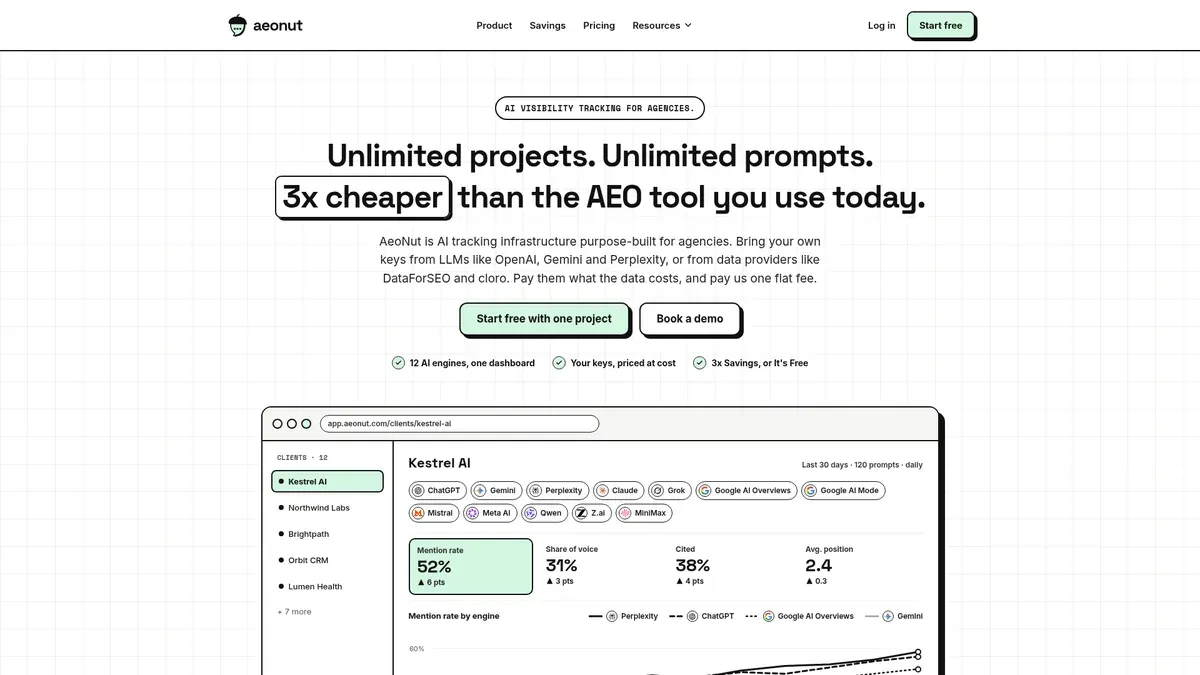
Best for: a freelance SEO or AEO consultant tracking one client over time, who wants a real prompt set and reports under their own brand.
AeoNut is the only AI visibility tracker that is free forever with unlimited prompts, and that matters for Claude because Claude tracking is where short trials hurt most. A seven-day window rarely shows a trend, and a client report needs more than one snapshot. On the Free plan there is no deadline to run into. You get one client project, no card, unlimited prompts and every feature, which includes analytics, white-label reports, the MCP server, the API and CSV export.
A project is one client brand with its own prompts, competitors, settings and reports. That fits the situation most freelancers are in, which is a first paying client or a prospect you want to impress. When a second client arrives you move to Pro, which is $99 a month for up to 10 client projects, or $79 a month billed annually. Every plan has every feature, so you never pay more to unlock Claude or reporting, only to hold more projects.
Claude is one of twelve engines AeoNut tracks, and Anthropic is one of the providers whose key you can connect. You add your key once, choose the prompts, countries and how often to run (daily, twice a week or weekly), and the tracking runs on that schedule. Each project reports Mention rate, Cited, Avg. position, Share of voice and Sentiment, with trends by engine, prompt and country. You can also open the raw answer Claude gave for each prompt, which is the part clients tend to want to read.
This is the part to read carefully if you are cost-sensitive. AeoNut never marks up the data. Your Anthropic account bills you directly at Anthropic's price, so a free platform does not mean free Claude answers. Anthropic says most organizations pay for API use through prepaid usage credits. Its web search tool is a separate fee of $10 per 1,000 searches on top of normal token charges. Not every answer uses a search, and some use more than one, so there is no honest flat price per answer to quote here.

What AeoNut gives you is control. A cost preview shows the estimated monthly data cost before tracking runs, you can see spend per client, and you can set budget caps and alerts. Keys are encrypted at rest, and AeoNut recommends restricted keys with spending limits and shows you how to set them in your provider account. If you start with 20 or 30 prompts, you can watch the preview and the real bill for a month and then decide whether to add more.
White-label client reports and shareable links carry your branding, not AeoNut's, and that holds on Free too. Reports export as PDF, Excel and Markdown, with CSV available as well. If you already use Claude for your own client work, the read-only MCP server lets it read the project's data, so it can help you draft a summary. That is a separate use from tracking: the tracking is what collects Claude's answers, and the MCP server is what lets an assistant read the results.
The Free plan covers one project, so a second client means Pro. Within that one project nothing is switched off, so a Claude brand mention tracker free of a platform fee is what the plan gives you. The other thing to be clear about is the collection route. AeoNut tracks Claude with the provider keys you connect, and it does not claim to be a copy of what one person sees in the Claude web app. If your requirement is specifically a capture of the consumer app, entry 5 below documents that.
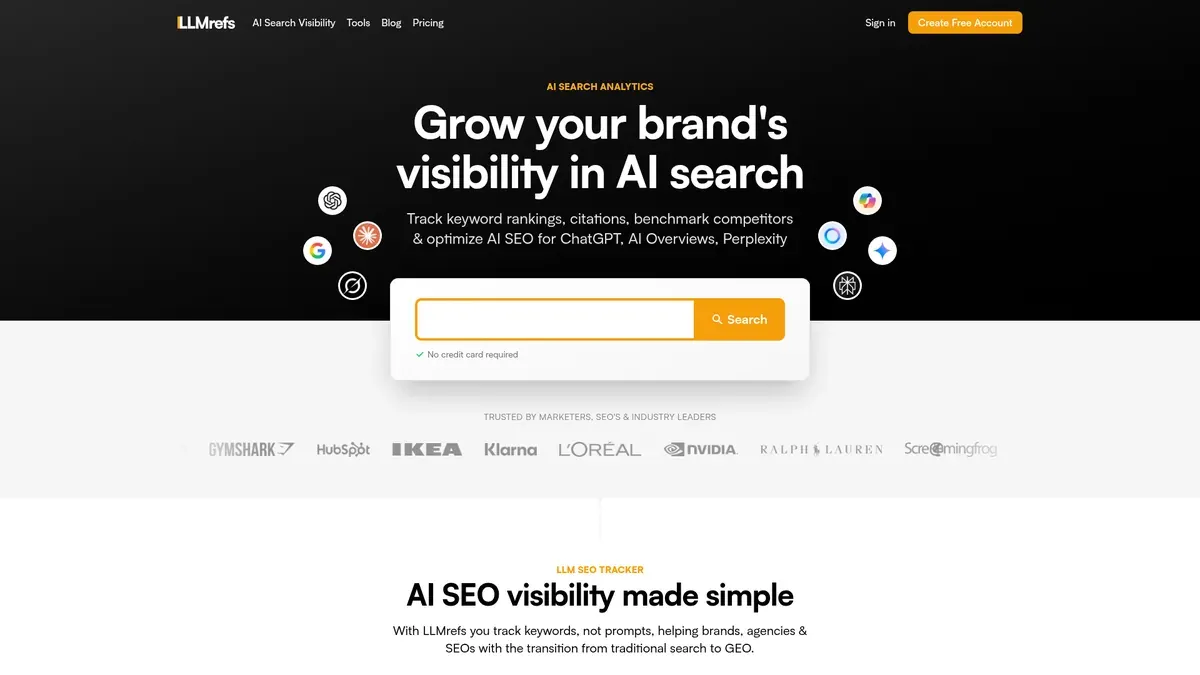
Best for: a consultant who would rather pay one hosted subscription than manage provider keys, and who works from keywords more than prompts.
LLMrefs includes Claude in its paid plan without an extra engine fee, which is its main strength for this job. You track keywords, and the tool generates related prompts from how people talk to AI chatbots. The All in One plan is advertised at $79 a month and lists 500 prompts covering brand mentions, sources and the generated follow-up questions. It also lists unlimited projects and team members, CSV export and API access, and weekly visibility reports.
The free part is a seven-day trial with no card. That is also where it stops short for this guide's question: there is no ongoing free monitoring, and the trial's own quota isn't published, so don't assume it matches the 500 prompts. The vendor's FAQ says each keyword updates at least once a week, which is a reasonable thing to check against how often your client wants fresh numbers. What happens to your dashboard and history when the trial ends is not documented, so ask before you build a client report on it. For a wider look at what you keep and give up when you leave a paid tracker, there is a separate guide.

Best for: a consultant who wants explicit no-surprise trial terms and is happy to pay a separate fee for Claude.
OtterlyAI is the clearest of the trial-based tools about what happens at the end. Its help pages say the seven-day trial ends automatically, needs no cancellation and applies no charges. The trial includes 50 search prompts, 1,000 API calls and 1,000 MCP calls, with no card needed. What those pages do not say is whether Claude is switched on during the trial, so confirm that before you plan an evaluation around it.
Claude is a paid add-on rather than part of the base plan. On monthly billing, Lite is $29 and the Claude add-on is another $29, so Claude on Lite is $58 a month for 15 search prompts. Standard is $189 plus $109 for Claude, which is $298 a month for 100 search prompts. Premium is $489 plus $439, which is $928 a month for 400 search prompts. Those totals are simple addition of the base and add-on prices, not plans OtterlyAI sells under one name. The vendor documents tracking brand mentions and citations over time, competitor benchmarking and the pages Claude cites, with daily tracking on its pricing pages.
The trade here is predictability against cost. You will know exactly when the trial ends, but if you are choosing Lite for Claude you should compare $58 a month, not the $29 headline. Whether your dashboards stay readable after the trial is not established.
Best for: a consultant comfortable managing a credit budget who wants configurable monitoring at a lower entry price.
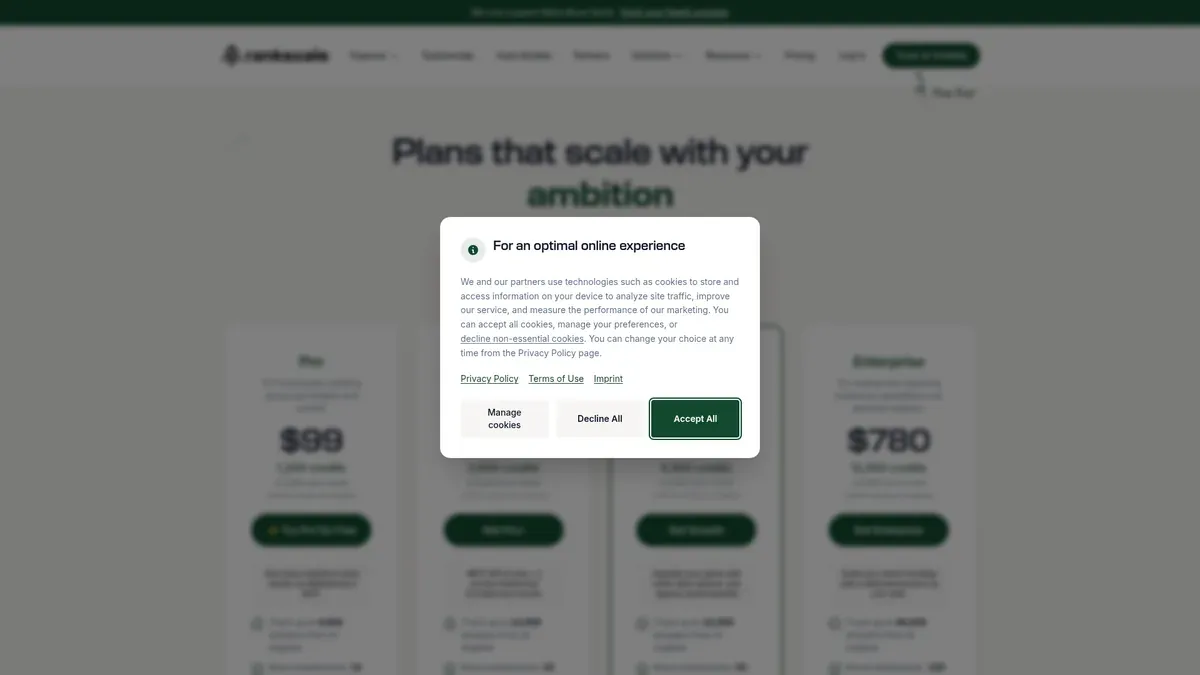
Rankscale supports Claude and offers a free test, and its pricing is built on credits. Essentials is shown at $17 a month equivalent, annual billing only, with 120 monthly credits. Pro is $99 a month ($84 on annual billing) with 1,200 credits. Growth, at $385 a month ($327 annual), lists white-label options for agencies.
The pricing FAQ says an engine query typically costs 0.25 credits per engine per prompt. At that general rate, 120 credits would be 480 answer runs in a month. That is arithmetic to show what the unit means, not a confirmed Claude rate, since the exact credit cost for Claude isn't established. So 120 credits is not 120 prompts, and it is not 480 prompts tracked daily either.
It documents mention, citation and sentiment analysis, source-domain analysis and settings for how often it updates, with a Data Studio connector, MCP and a REST API on higher plans. The part to be careful with is the free test. Its length, how many credits you get, whether it needs a card and whether Claude is included are all unpublished in the pages reviewed, so it is not evidence of a recurring free Claude allowance. If you want a paid tool you can scope tightly, it is worth a look. If you want free and ongoing, it is not that.

Best for: a consultant whose requirement is specifically answers captured from the Claude consumer web app, and who can pay after a short trial.
GEOflux describes its collection method more plainly than anyone else here. Each prompt is asked in the Claude web app, the answer shown is captured, and source chips are recorded when Claude searches the web. It reports brand mentions, descriptions and citations, along with Share of Voice, visibility percentage and sentiment trends, and offers reports, CSV export and email digests. Client seats are advertised as unlimited across plans.
The catch is the lesson of this whole article. GEOflux has a lasting Free plan, and it has Claude support, but the Free plan excludes Claude. The free offer lists 45 credits with tracking every three days, and Claude is not part of it. Claude comes on during a 14-day, no-card trial and on the paid Starter (150 credits) and Growth (450 credits) plans, at three credits per prompt run. So 150 credits is 50 Claude runs and 450 is 150 runs. Those are runs, not distinct prompts tracked every day.
A tool can honestly advertise both a free plan and Claude support without giving you free ongoing Claude tracking. Exact paid prices were not established in the pages reviewed, so plan for a paid subscription after the trial. How the downgrade works, and what happens to your history, is not documented.

Best for: a freelancer who needs a quick Claude snapshot for a prospect call and does not need a trend yet.
The page is called a free Claude rank tracker, but its FAQ makes the distinction that counts: the first report is free, and scheduled tracking is paid. You enter a brand name, a domain and the buyer questions, including your own custom ones. The tool asks Claude the same questions more than once, because a single answer is not a pattern. The report offers an AI Visibility Score, a shortlist position, top queries where the brand appears, missed opportunities and a competitor leaderboard. Those are the vendor's own labels, and the "about two minutes" is its own estimate, not a measured promise.
It suits the first conversation with a prospect well, and it is the one entry here that is closer to a checker than a tracker. It does not give you month-over-month numbers, and the free prompt allowance, the paid price and any export or white-label options were not established. Repeating questions inside one report is not the same as a free subscription that keeps collecting.
Pick by the job you have, not by the longest feature list.
If you are still deciding which kind of free offer fits you, that choice has a guide of its own.
If you want to track Claude with unlimited prompts and keep your client reports under your own brand, start free with one AeoNut project. The platform has no trial clock, and your provider bills you for the answer data.
Yes. AeoNut's Free plan includes Claude tracking, unlimited prompts and every feature for one project, with no time limit and no card. You bring your own provider key and pay the provider for the data, so the platform is free but answer collection can cost money.
AeoNut puts no platform cap on prompts on its Free plan. That does not mean unlimited free Claude answers: how often you run, how many prompts you add and your provider's prices set the data bill. Other tools meter runs or credits rather than saved prompts, so compare the units before you compare the headline numbers.
It depends on the tool. OtterlyAI says its seven-day trial ends automatically with no charges, though Claude's place in that trial is not confirmed. LLMrefs advertises a seven-day trial without documenting post-trial access. GEOflux offers a 14-day trial with Claude, but its lasting Free plan excludes Claude. Don't assume a trial turns into free ongoing monitoring.
A first report supports an opening conversation, but it does not give you recurring collection or a trend. TrackMyVisibility says as much by separating its free first report from paid scheduled tracking. For ongoing client reporting, pick a tool with continuing collection and a clear data budget.
Tools & Comparisons ·
Compare free tools that report citation rate and brand mention rate as separate numbers, and see which are ongoing plans and which are one-time checkers.

Tools & Comparisons ·
Is a self-hosted AI visibility tracker worth your time? Compare setup, upkeep, data control and engine coverage with a managed free plan before you decide.

Tools & Comparisons ·
Which free AEO tracking tool keeps running, saves history and shows change? Compare five free options on schedule, trends and alerts to pick one for a client.