Tools & Comparisons ·
Free Tools That Track Citations and Brand Mentions Separately
Compare free tools that report citation rate and brand mention rate as separate numbers, and see which are ongoing plans and which are one-time checkers.
Should you use a free trial or a free forever plan to monitor ChatGPT? See what each lets you finish, what happens when it ends, and which fits your project.
Avinash Saurabh · · 17 min read
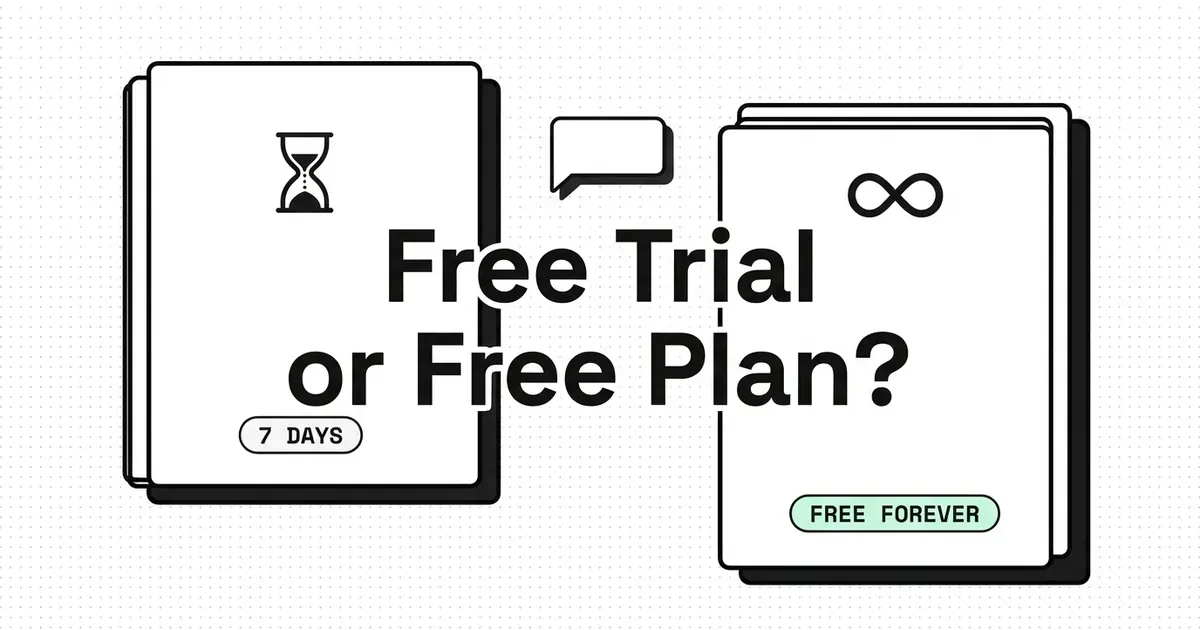
If you need to keep monitoring a client in ChatGPT after the evaluation week, start with a free plan. If you are testing whether a paid platform fits your workflow, use its trial. That is the short answer, and most of this guide is about why the two jobs are different. AeoNut's Free plan is free forever, with unlimited prompts and your own keys, so a ChatGPT monitoring free plan like this keeps one brand's tracking running without a platform fee. Your provider still bills you for the AI answer data, and I'll come back to that, because it's the part people skip over.
The decision is not really about who gives you the most prompts. It's about whether the free access lasts long enough for the job you actually have, whether the reporting you need is included, and what happens when it ends. Free trials for ChatGPT monitoring tools answer one question well, which is whether you'd pay for that product. A free plan answers a different one, which is what changed for this client since the last report. Our overview of which kind of free offer fits sits behind this guide.
I'm assuming you're a freelancer or a one-person shop with one client to start. The facts below were checked for November 2026, and I'll say where the public material didn't settle something.
| Option | Free-access model | What you can finish with it | What happens at the end | Cost boundary and best fit |
|---|---|---|---|---|
| AeoNut Free | Free forever platform plan for one client project, no card, unlimited prompts, every feature | A baseline, scheduled ChatGPT tracking over time, competitor comparison, white-label client reports | No trial expiry. You upgrade only for more client projects, not to unlock features | Platform is $0, provider data is billed separately. Best for an ongoing one-brand engagement |
| OtterlyAI trial | Seven-day free trial, no card | Judging the interface, the daily monitoring workflow and citation-source analysis | Ends automatically after seven days, with no cancellation steps and no charge | Paid plans start at $29 a month. Best for a bounded buying decision |
| Peec AI trial | Free trial advertised, duration and card terms not confirmed in public material | Judging whether Peec's workflow fits, subject to the actual trial terms | Conversion, access after expiry and retention were not established | Brand plans start at $95 a month as displayed. Best if you are considering Peec specifically |
| AEObot Free | Ongoing $0 plan, one workspace, monthly ChatGPT visibility scan, no card | A first diagnostic and a monthly check-in | No trial countdown is stated. Weekly scans are an upgrade | Starter is $50 a month. Best when monthly checks are enough |
| Ahrefs AI Visibility Checker | Free diagnostic, no signup, no card | A first snapshot that includes a ChatGPT breakdown | Nothing expires, but it is not a tracking workspace with history | Free. Best for a first conversation, not recurring client monitoring |
One caution on the table. A feature on a paid pricing grid doesn't prove the trial includes it. Where trial-specific export, reporting or retention terms weren't established, I've left them unknown instead of marking them included.

AeoNut is AI visibility tracking built for agencies, and that includes an agency of one. Each client brand is a project with its own prompts, competitors, country, schedule and reports. The Free plan gives you one of those projects, unlimited prompts, and every feature the paid plans have, including white-label reports, CSV export, the API and the MCP server. There's no card. It is the only AI visibility tracker that is free forever with unlimited prompts, which makes it the one ChatGPT tracker free forever option I'd call complete for this job, and I'm using the full wording on purpose, since some tools have credit-capped free plans and others offer one-off checkers, which aren't ongoing tracking.
For a ChatGPT monitoring free plan to be useful to a consultant, it has to let you finish real work. Here is what Free lets you do for one client:

This is the part to read twice. The Free plan costs $0 and stays at $0. The AI answer data does not. You connect your own key, and the provider bills you directly at its own price. AeoNut doesn't mark that data up, and it shows an estimated monthly cost before any tracking runs. So the honest description is a free platform plus data at cost, not free tracking.
For ChatGPT you also choose what you're measuring. AeoNut can use scraped data, which is the answer people see in the ChatGPT app, or API data from a model you pick. They're two different observation surfaces, and an API response isn't automatically the same thing a person sees in ChatGPT. I'd write that choice into your report so the client knows which one they're looking at. One key from a single provider is enough to start, and OpenAI and DataForSEO are the usual ones for ChatGPT.
The worry I hear most from consultants is the surprise bill. AeoNut handles it with the cost preview, spend shown per client, budget caps and alerts. It also recommends restricted keys with spending limits and shows you how to set them up. Keys are encrypted at rest and never shown again after you save them. I wouldn't call keys effortless, because you do have to set them up, and there's a free setup call if you'd like someone to walk through it.

Free holds one client project. For the engagement you're trying to start, that's the whole job. When you add a second client, Pro covers up to 10 client projects for $99 a month, or $79 a month billed annually, with the same features. Unlimited is $499 a month, or $399 billed annually, with no project ceiling. Data costs stay separate on every plan. If you move to a paid plan, your history carries over, and the Done-For-You Switch can import prompts, competitors and tracking history from the tool you're leaving.
If you're weighing this against several single-engine tools, per-engine free checkers or one free tracker compares the two approaches.
Best fit: a hands-on freelancer who's comfortable with API keys, needs one brand to keep running, and wants reports under their own name without a platform subscription.

OtterlyAI is the clearest example of a ChatGPT visibility tracker free trial, because its help material spells out the terms. The trial lasts seven days, needs no credit card, and ends automatically. You don't have to cancel anything and nothing is charged at the end. If you've read elsewhere that it's a 14-day trial or that it quietly bills a card, that doesn't match its current help pages.
After the trial, the paid plans are Lite at $29 a month, Standard at $189 and Premium at $489, shown in US dollars excluding tax. A November 10, 2026 pricing announcement confirms those three prices and says the structure applies to new users and trials from that date. ChatGPT monitoring is supported, daily tracking is the default it describes, and the pricing page lists citation-source tracking, reporting and export.
What can seven days finish? Quite a lot of evaluation. You can see whether setup works, whether the results make sense, whether the citation analysis helps you, and whether the paid workflow is worth buying. What you can't get is data from a reporting period that hasn't happened yet, so a client report that spans several weeks won't fit inside the trial. That's a calendar limit, not a flaw.
It helps to keep three events apart, because they get blurred:
OtterlyAI suits you if you want to assess one packaged product inside a week and you're ready to pay if it fits. The no-card trial removes the risk of an unwanted charge, but it doesn't give you a documented runway for ongoing monitoring. If the one-brand engagement has to keep going without a platform subscription, AeoNut is the more natural place to start.

Peec advertises a free trial and has a solid visibility-analysis workflow, but the public pricing material I reviewed doesn't settle the trial's length, whether a card is needed, or whether it converts automatically. That makes it a poor anchor for a comparison about how long a trial lasts, so I'm treating it as a secondary example.
Its brand plans are shown as Starter at $95 a month, Pro at $245 and Advanced at $495, with a 15% discount advertised for annual billing. These are brand-plan prices, not an agency quote, and I couldn't establish the agency amounts, so don't multiply Starter by your client count and call it Peec's agency bill.
On features, ChatGPT is supported with daily tracking, position, sentiment and share of voice, and API access starts at Pro. White-label reporting wasn't established, and a shareable dashboard isn't the same as a white-label client report.
One term matters for a consultant. Peec's Master Customer Agreement, last updated October 22, 2026, says evaluation use is for your internal evaluation during a period Peec designates, with a 30-day fallback if it doesn't designate one. That fallback isn't proof the standard signup trial is 30 days, so I wouldn't advertise it as one. What it does tell you is that an evaluation account isn't meant for external client deliverables, which is the thing an agency of one would most want to do with it.
Peec fits someone weighing its paid analytics workflow who is willing to read the actual signup terms first. For a freelancer whose first requirement is one ongoing project with no platform fee, AeoNut gives you a clearer published starting point.

AEObot is a useful reality check, because free access isn't limited to AeoNut or an expiring trial. Its Free plan is an ongoing $0 tier with one brand workspace and a monthly AI visibility scan that includes ChatGPT. It doesn't ask for a card.
Starter is $50 a month for weekly scans and visibility reports, and it includes Google Search Console connectivity and MCP access. Growth is $250 a month for daily scans and citation alerts.
What can you finish on it? A monthly diagnostic, or a low-frequency client check-in. If a monthly look is all the engagement needs, that's a real strength, and the free tier doesn't run on a countdown. I couldn't confirm white-label reports or exports on the free tier, so I haven't marked them as included.
Monthly is the boundary. If the client wants to see changes weekly or daily, the upgrade path is the $50 plan. AeoNut fits better when you want the schedule you choose and white-label reports on the free platform plan, with provider data billed separately.

The Ahrefs checker is free, needs no signup and no card, and doesn't limit how many brands you can check. You can enter a brand, a product or a competitor. The report gives total AI mentions, a platform breakdown that includes ChatGPT, and the top cited domains and pages.
That's a good first result for a conversation with a prospect. The total mention count covers several platforms, so it isn't a ChatGPT-only number, and if you write about ChatGPT you should use the ChatGPT line in the breakdown. Ahrefs sends people to its separate Brand Radar product for historical tracking and competitor comparison, and I couldn't establish a scheduled workspace, white-label reports or exports for the free checker.
A checker answers a point-in-time question. You can repeat it by hand and get more observations, but then you're the one doing the repeated work, and nothing keeps comparable results for you. For a deeper look at that split, our guide on choosing between a free plan, a free trial and a one-off checker goes through all three.
Here's a way to connect all of this to how long your project runs, and the guide on free tracking by reader and industry has more setups like it. These are planning scenarios, not tested minimums. Nothing I found says seven, 14 or 30 days proves a trend, so the right window depends on your questions, schedule and what you're measuring.
| Your job | Access model that fits | What you can finish | Main trap |
|---|---|---|---|
| Answer a prospect's visibility question today | Free checker, or a first run in an ongoing plan | A dated baseline and example answers | Presenting a snapshot as a trend |
| Decide if a specific paid tool is worth buying this week | A documented short trial | Setup, workflow check, a purchase decision | Assuming every paid report or export is on in the trial |
| Deliver a report covering several weeks | An ongoing plan, or a paid plan that spans the period | Comparable observations across the window | A trial that ends before the later data exists |
| Run a one-brand retainer for several months | An ongoing free plan with the right cadence, reporting and data budget | Repeated client reports in one project | Treating a leftover free account as full monitoring |
| Add more client brands | A plan with more projects | Separate scope and reporting per client | Comparing brand packages with agency packages |
Use this as a product evaluation, not a promise about what any vendor's trial permits:
If you want a closer look at what carries over when you leave a paid tool, what you keep and give up with free alternatives covers it.
Whichever route you take, a monitored result is a defined observation and not everyone's ChatGPT experience. OpenAI explains that ChatGPT can search on its own, can rewrite a question into more targeted search queries, and may use relevant saved memories when it does. So record the country, the prompt, the data surface and the date next to every result.
The same goes for API data. OpenAI's API supports web search with sourced citations and accepts an approximate user location, so the old claim that the API can't search the web or return links is out of date. That still doesn't prove an API request behaves the same as the consumer ChatGPT app, which is why naming what you sampled matters.
A mention and a citation are also different things. A brand can be named without its own site being cited, and a citation can point to an outside page that talks about the brand. Neither one proves a sale or a lead, or that your work caused a change. OpenAI warns that citations can be incomplete or wrong, so read a few raw answers and the cited pages before you turn a dashboard number into advice. We also looked at how free ChatGPT rank trackers with no prompt cap handle position if you want to go further on that metric.
The guide to free AI visibility tools by job matches other tracking tasks to tools. The research here doesn't include any independent study showing that a free plan improves visibility, or that a certain number of days gives a meaningful trend, so what follows is a judgment about fit and not a measured result.
"Free forever" is the current plan promise, not a contract that a vendor can never change its terms, and that applies to every plan in this guide, ours included. Before you build a client's tracking on any of them, it's worth testing the claim yourself, and how to test a free forever claim walks through reading plan pages for credit caps and expiry wording. If your next question is which limit will hit you first, free AI visibility plan limits compared lays them side by side.
If the engagement is going to keep running, start AeoNut Free for one client. It needs no card, the platform is free, and your provider bills the answer data at its own price, with a cost preview before anything runs.
Choose a free plan when the monitoring has to continue through recurring client reports without a platform subscription. Choose a trial when you're deciding whether to buy one specific paid product inside its evaluation window. For one client, AeoNut Free gives you ongoing platform access with unlimited prompts and every feature, and the provider bills the data separately.
The platform is free for one client project and needs no card. You supply your own provider keys and pay the provider for the AI answer data, and AeoNut shows an estimated monthly cost before tracking runs. So it isn't free data or zero total running cost.
It depends on the product. OtterlyAI's seven-day trial ends automatically, with no cancellation steps and no charge, but its trial-specific retention terms weren't established. Peec's standard trial length, conversion and retention weren't established in the public material I reviewed. Don't carry one vendor's terms over to another.
A checker gives you a useful baseline, but it doesn't necessarily keep a schedule, history, client setup or reporting workflow. The Ahrefs checker is a diagnostic, AEObot Free adds monthly scans, and AeoNut Free supports an ongoing one-client project with a schedule you choose and white-label reporting, with provider data billed separately.
Tools & Comparisons ·
Compare free tools that report citation rate and brand mention rate as separate numbers, and see which are ongoing plans and which are one-time checkers.

Tools & Comparisons ·
Is a self-hosted AI visibility tracker worth your time? Compare setup, upkeep, data control and engine coverage with a managed free plan before you decide.

Tools & Comparisons ·
Which free AEO tracking tool keeps running, saves history and shows change? Compare five free options on schedule, trends and alerts to pick one for a client.