
Tools & Comparisons ·
Free Tools That Track Citations and Brand Mentions Separately
Compare free tools that report citation rate and brand mention rate as separate numbers, and see which are ongoing plans and which are one-time checkers.
Looking for a Profound free alternative? Compare five free options, see which track ongoing and which are one-off checks, and pick the right one for your team.
Avinash Saurabh · · 16 min read
If you are a freelancer, a small team or a one-person consultancy, and a client has asked whether they show up in ChatGPT, you have probably looked at Profound by now. It is a well-known name in AI visibility tracking, and it is also built for larger buying processes. So the next thing you typed was likely "profound free alternative," hoping to find something you can start today without a sales call or a card. Many people searching for Profound alternatives free of a sales call and a card land on the same few names, so this list sorts them by what you actually get.
This guide is a shortlist of those options, and it sits inside our wider look at free AI visibility tools. Before the list, it helps to be clear on one word, because "free" means four different things in this market. A free plan keeps running and has no end date. A free trial stops after a set number of days. A free checker gives you one score, once. And a free platform can still leave you paying for the data underneath it. Only the first kind lets you show a client a trend, and that is the kind most of this article is about.
I ranked the tools below on five things. Can a small team start without a sales call or a subscription? Does access continue after a trial? Does the tool track your prompts again and again, or hand you one report? Does it cover the engines your clients ask about? And what does the free offer leave out? For consultants I also looked at competitor context, client-ready reports and whether any data costs sit outside the platform price.
Here is the short answer. Only two of the five tools can track the same prompts over time for free, AeoNut and GEOflux, and their limits are quite different. The other three are free checks, which are fine for a first look and will not give you a trend.
Since the title asks about alternatives to Profound, it is fair to look at what Profound itself gives away. Its pricing page, checked in November 2026, shows a free seven-day Trial and an Enterprise tier with custom pricing. The Trial runs 50 prompts daily for seven days on ChatGPT, Gemini and Google AI Overviews. The prompt set is recommended for you based on your industry, so you cannot swap in your own, and the trial credits are a one-time amount that does not renew. Its comparison table lists the trial as limited to one language and one region, with no history, no exports and no API.
That makes the Trial a reasonable way to look at Profound itself before you decide whether to buy. It is not a free plan, because it ends. If you want the narrower question of prompt caps, we cover it in free Profound alternative with unlimited prompts. The pricing page also mentions an Agency Growth plan, and Profound's credit documentation says it carries 400 credits a month per client workspace, but the page shows no dollar price for it. AeoNut's own savings calculator, built from public pricing in November 2026, uses $399 a month per client workspace for Profound's agency plan, so if that number matters to your decision, check Profound's live pricing before you rely on it.
The honest answer to "is there a free alternative to Profound AI" depends on what you mean by free, and none of this makes the question wrong, and if enterprise platforms in general are what you want to avoid, free alternatives to enterprise GEO platforms widens the list. It just means the real question is what to use once a seven-day trial is over and you still have a client to report to.
| Rank and tool | What is free | Ongoing tracking? | Main trade-off | Best fit |
|---|---|---|---|---|
| 1. AeoNut | $0 forever, one client project, no card | Yes | Unlimited prompts and every feature, but you bring provider keys and pay providers for data | One client brand that needs lasting, client-ready tracking |
| 2. GEOflux | $0 forever while free slots last | Yes, prompts re-asked every three days | 15 prompts, three engines, three competitors, free accounts capped at 500 | A small prompt set on ChatGPT, Gemini and Google AI Mode |
| 3. Ahrefs AI Visibility Checker | Free, no signup | No | A snapshot, with history in paid Brand Radar | A fast first look across six platforms |
| 4. Semrush AI Search Visibility Checker | Free, no account, three uses a day | No | A report, with deeper tracking in the paid toolkit | Repeated manual checks |
| 5. HubSpot AI Search Grader | Free, one-time check, no account | No | A snapshot on three AI systems | A quick brand-perception baseline |

Best for: a freelancer, consultant or small team tracking one client or one brand all the time, who needs prompt-level evidence and a report they can put their own name on, and who is not ready to pay a monthly platform fee.
AeoNut is the one built for the situation in the title, so it makes sense to start here. The Free plan costs $0 forever, takes no card, and holds one client project. It includes every feature AeoNut has, and it has no cap on prompts or team seats. That matters more than it sounds, because a prompt cap is usually the first thing that forces a consultant to pick which of the client's questions to leave out.
The Free plan tracks twelve engines: ChatGPT, Gemini, Perplexity, Claude, Grok, Google AI Overviews, Google AI Mode, Mistral, Meta AI, Qwen, Z.ai and MiniMax. For each project you choose the engines, the countries, the prompts and how often it runs, which can be daily, twice a week or weekly. For each engine you can also pick scraped data, which is the answer a real person sees in the app, or API data from a specific model. Setup is short. You create the project, add prompts, connect a provider key and start tracking, and one key from a single provider is enough to begin. So you can start with one client, twenty or thirty of their real buyer questions and three engines, and let it run for a few weeks. That gives you a trend to show them, and a trend is the thing a one-off score cannot give you.
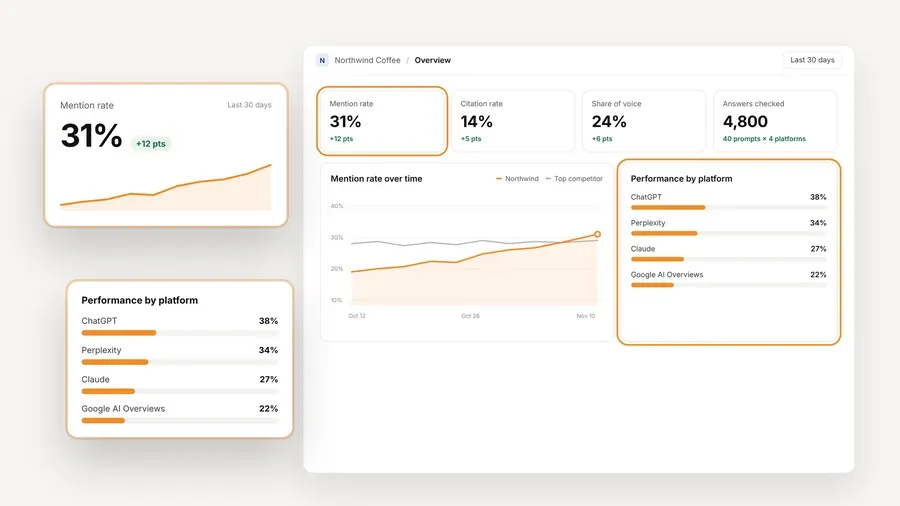
Each project reports Mention rate, citation rate, average position in the answer, Share of voice against the competitors you track, and Sentiment, broken down by engine, prompt and country. You can open the raw AI answer for every prompt, see which sources were cited, and see which cited pages belong to the client, to a competitor or to neither. When the client asks why a number moved, you can show them the actual answer.
Reporting is where a lot of free tools fall away, and it is included here. White-label client reports carry your branding rather than AeoNut's, and they export as PDF, Excel and Markdown, with CSV export for the raw data. A read-only MCP server and a read-only API come with the plan too, so an assistant like Claude can read the workspace and help you draft the monthly summary.

Now the part you should hear plainly. Free means the AeoNut platform fee is $0. The AI answer data is not free. You connect your own key from OpenAI, Anthropic, Gemini, Perplexity or DataForSEO, and that provider bills you directly at its own price, with no markup from AeoNut. A cost preview shows the estimated monthly cost before anything runs, and you can set spend limits per client, budget caps and alerts. One example AeoNut publishes is about $135 a month in data for 10 clients with 100 prompts each, tracked daily on ChatGPT, Perplexity and Google AI Overview. That is a ten-client figure, so a single client on a lighter schedule costs far less, and the preview will tell you the actual number before you commit to a schedule.
The one real limit is the single client project. If you end up with several clients who each need their own tracking, you move to Pro, which is $99 a month for up to 10 client projects, or Unlimited at $499 a month. Plans differ only in how many client projects they hold, and your history comes with you, so the first client's tracking is not wasted.

Best for: a small team that wants a recurring tracker with a strict but easy-to-understand free scope, and whose first set of questions fits in 15 prompts.
GEOflux has a Free plan that keeps running. From its free tracker page, it tracks 15 prompts on ChatGPT, Gemini and Google AI Mode, re-asks them every three days, and follows three competitors. It records complete answers and keeps an answer history, so you can see changes across runs. The free plan includes Overview, Answers, Sources, Brands and Topics views, email digests and three shareable reports per project, and team members and client access are listed as unlimited.
If your first client has a tight set of questions, this is a sensible free tracker, and it is the other ongoing option in this research. The limits are worth reading before you build a client's reporting on it, though. Free covers three engines, so Perplexity and Google AI Overviews are not included until you pay. There is no CSV export on Free. And free accounts are capped at 500, with a waitlist once those are taken, so you cannot count on getting in on the day you decide to start.
There is also one thing the page does not make clear. It says 45 credits cover 15 prompts across three engines, and it also says prompts are re-asked every three days, but it does not explain whether credits renew. So I would not promise a client an endless run of checks until you have seen how it behaves on your own account. The page also says new prompt runs pause after 90 days without logging in, and your saved data is not deleted.
Starter is $99 a month and Growth is $199 a month, both with daily tracking and eight engines. A separate 14-day trial exists, and a Free account cannot be converted into it.

Best for: a team that wants to look at a domain quickly without creating an account, or one that already uses Ahrefs and may later pay for custom prompts.
The free checker needs no signup and gives you an instant read on a domain across ChatGPT, Gemini, Perplexity, Copilot, Google AI Overviews and Google AI Mode. The report shows total mentions, a breakdown by platform, the topics or prompts tied to those mentions, and the domains or pages cited alongside the brand. For a first conversation with a prospect, that is a handy way to show something real in five minutes.
It is a checker, so it does not hold your own prompts and re-run them. Ahrefs puts historical monitoring in its paid Brand Radar, and free alternative to Ahrefs Brand Radar covers whether a free tracker with your own prompts can stand in for it. Brand Radar's AI Visibility Index starts at $199 a month and measures against a pre-collected set of prompts based on real search demand, and Custom Prompts starts at $50 a month and tracks the questions you define, with data building up from the day you begin. Those are two different products with different ways of collecting data, so a free snapshot should not be read as either one.
Best for: a small team that wants a free, no-account check several times a day, or one that already uses Semrush and might move up to its AI Visibility Toolkit.
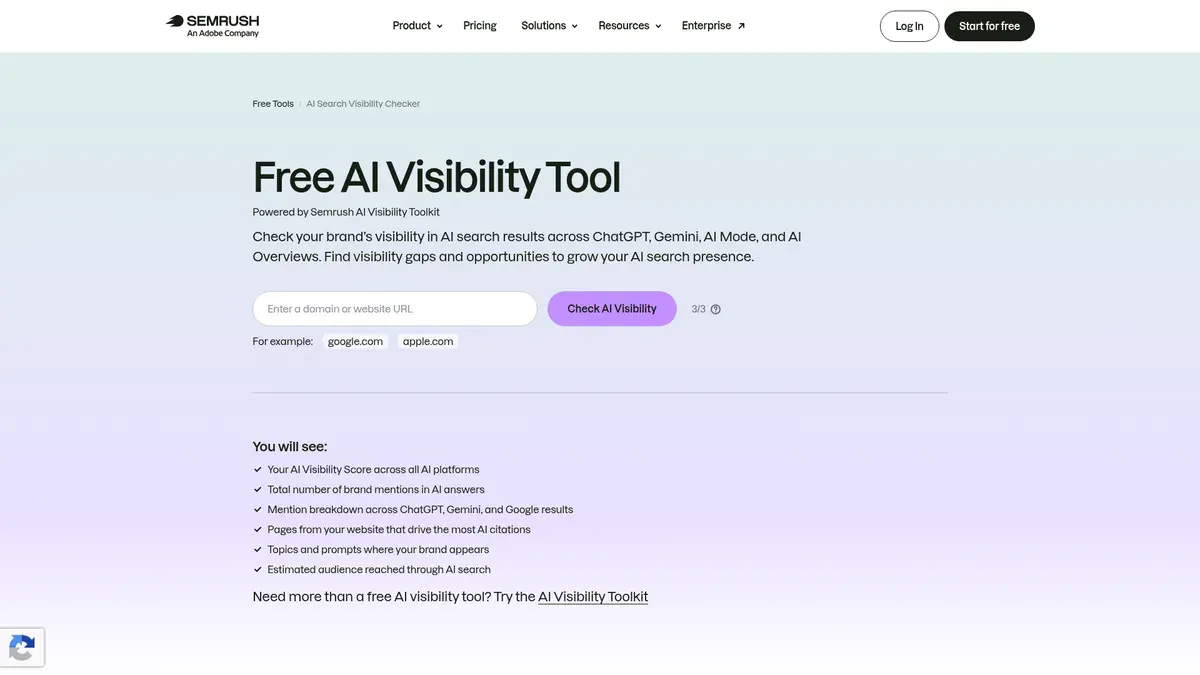
The checker covers ChatGPT, Gemini, Google AI Overviews and Google AI Mode, and you can run it three times a day without registering. The report includes an AI Visibility Score, mentions, citations, estimated audience reach, top cited pages, topics and a competitor comparison. Semrush says it draws on a database of more than 26 million prompts and responses, which describes the size of its database and says nothing about how many prompts of your own you can track.
Because you can run it three times a day, you could build a rough manual record by checking on a schedule and saving each report. That takes effort, and it is still a series of separate snapshots. For real tracking, the AI Visibility Toolkit Base plan is $99 a month per domain billed annually, and it advertises a seven-day free trial. The reviewed page does not say whether that trial needs a card, so check before you sign up. Scheduled reports and PDF export are add-ons at $10 a month, and branding and white-labeling sit in a $20 a month add-on.

Best for: a consultant who needs a quick, no-account baseline of how AI describes a brand, with a written interpretation to go with it.
You give the AI Search Grader a company name, location, industry and product details, and in under two minutes you get a score out of 100 across ChatGPT, Perplexity and Gemini. The score is weighted toward Sentiment Results at 40 points, with Presence Quality and Brand Recognition at 20 each, and AI Share of Voice and Market Competition at 10 each. The page says no account is needed.
It is explicitly a one-time check, so it cannot show you a trend or repeat your own prompts. HubSpot sells a separate paid product, HubSpot AEO, at $50 a month for ongoing monitoring across the same three systems, and the grader does not include what that product does. If you want to move from the grader to ongoing tracking, free HubSpot AEO alternative walks through the steps. Used on its own, the grader is a good way to open a conversation with a client about how AI currently describes them.
Every free option here asks you to give something up, so it helps to decide ahead of time which gap you can live with. Here is how I would think about it for a small team.
If you only need an initial diagnosis for a pitch, a one-time report is enough, and the Ahrefs, Semrush and HubSpot options all do that without an account. You give up trend lines and your own prompts, and for a pitch that is usually fine.
If you must report prompt-level changes to a client month after month, a single score is a real gap, and you need one of the two ongoing options. Between those two, the question is how many questions you need to track and on which engines, and free AI visibility plan limits compared lists prompts, engines and projects for several free plans in one place. A tight set of 15 questions on ChatGPT, Gemini and Google AI Mode fits GEOflux. A larger set, or Perplexity, Google AI Overviews or Claude, points to AeoNut, as long as you accept the provider charges and the one-project ceiling. If you are unsure which kind of free offer fits you, free plan, free trial or checker lays out the three kinds side by side, and free forever claims shows how to test a claim yourself.
A sensible order for many consultants is to run one of the free checkers for the pitch, then set up a tracker for the client who says yes. The checker gets you the first conversation, and the tracker is what gives you something to say in the third month.
If you worry about losing your history, ask every tool what happens to your data when the free period ends. We cover that in what happens to your data. And if you have already started on one tool, free plan is no longer enough helps you spot the point where you should move.
Pick AeoNut if you track one brand, want no cap on prompts, need Perplexity, Google AI Overviews or Claude in the mix, and want a white-label report you can send under your own name. Estimate your data cost with the cost preview first, and use restricted keys with spending limits.
If you need a Profound alternative small teams can start on today, the first two picks are the ones to try. Pick GEOflux if a small, fixed set of 15 prompts on three engines covers your client's questions, and you are happy to take a free slot while they last. It is also a fair choice when you would rather not set up provider keys at all.
Pick one of the free checkers if what you need is a first look or a pitch asset. Ahrefs has the widest platform list, Semrush lets you run it three times a day, and HubSpot adds a written read of how the brand is perceived. Use them to open the conversation, and move to a tracker when the client wants to see change.
Pick Profound if you have a larger buying process, you are ready to talk to sales, and the Trial shows you what you need before you commit. The seven days are enough to judge the product, but as a Profound free alternative for ongoing client reporting the Trial runs out too soon.
If you want to see what the first option looks like with your own client's questions in it, start free with AeoNut. It is free forever, takes no card, and you bring your own keys.
Profound advertises a free seven-day Trial that runs 50 prompts daily, with a limited amount of one-time credits. The trial does not renew, and it is different from an ongoing free plan.
For ongoing prompt tracking, AeoNut and GEOflux are the clearest free options. AeoNut has unlimited prompts and twelve engines but one project on Free, and the data is billed by your own provider. GEOflux limits Free to 15 prompts on three engines and caps free accounts at 500. Ahrefs, Semrush and HubSpot offer free checks, which are useful for a first look and do not replace tracking over time.
Not on AeoNut. The platform fee is $0 on the Free plan, and you pay your provider for the data at its price. The cost preview shows the estimate before anything runs, and budget caps and alerts help you keep it under control.
A one-time grader or a snapshot cannot show a trend by itself. A tracker that repeats your prompts on a schedule and keeps the answers can, which is why AeoNut and GEOflux are the two options here that fit that job.
Tools & Comparisons ·
Compare free tools that report citation rate and brand mention rate as separate numbers, and see which are ongoing plans and which are one-time checkers.

Tools & Comparisons ·
Is a self-hosted AI visibility tracker worth your time? Compare setup, upkeep, data control and engine coverage with a managed free plan before you decide.

Tools & Comparisons ·
Which free AEO tracking tool keeps running, saves history and shows change? Compare five free options on schedule, trends and alerts to pick one for a client.