
Tools & Comparisons ·
Free Tools That Track Citations and Brand Mentions Separately
Compare free tools that report citation rate and brand mention rate as separate numbers, and see which are ongoing plans and which are one-time checkers.
Looking for a free Evertune alternative? Compare five free ways to track AI brand visibility, start without a demo or card, and see what each one really covers.
Avinash Saurabh · · 17 min read
When a client asks whether the brand shows up in ChatGPT, you want a real answer from real AI responses, and you want it without booking a call or paying a monthly bill before the client has paid you. If you have been looking at Evertune and wondering about a free Evertune alternative, this guide is for you. It compares five ways to get AI brand tracking started today, and it starts with one that you can sign up for yourself, with no demo and no card.
Here is the short version. AeoNut's Free plan is the only AI visibility tracker that is free forever with unlimited prompts, and it tracks one client project on twelve AI engines with every feature included. You bring your own provider key, so the platform costs nothing and the AI answer data is what your provider charges. The other four options are useful, but each one is either a capped plan or a one-time snapshot, and we say so plainly below.
One correction up front, because the title of this guide invites a wrong idea. Evertune does not require a sales demo. Its current pricing page has a direct "Get started" route for its Starter tier, and a demo is simply one more option on the site. What Evertune does not list is a permanent free plan, and that is the real reason a freelancer might look elsewhere. So when you look for an Evertune alternative no demo is involved in, that describes how you can start with the tools listed here. It is not a claim about how Evertune works.
A freelance consultant needs something different from a marketing team, so we ranked every tool against the same five questions.
If you want to sort free plans, trials and checkers before you read on, see which kind of free offer fits. We also kept one rule. A snapshot is a snapshot, and a capped plan is a capped plan. A free checker gives you one score at one moment, which is useful for a first look, but it cannot show a client a trend. When a tool measures something different from the others, we say that instead of lining the numbers up as if they matched.
| Tool | What is free | Ongoing tracking? | Best fit | Key boundary |
|---|---|---|---|---|
| AeoNut | Free forever: one client project, unlimited prompts, every feature, no card; you supply a provider key | Yes | A freelancer who wants a continuing tracker for one client | The platform is free; your provider bills for answer data at its own rates |
| Rankbits | $0 forever: one brand, five prompts, five engines and search sources, 100 AI responses a month | Yes, weekly | Someone who wants a small hosted free plan with scheduled scans | Five prompts and 100 responses a month; no exports on Free |
| Ahrefs AI Visibility Checker | One-time check, no signup or card, limited preview across six platforms | No, snapshot only | A quick baseline across several platforms | Limited preview; the paid Brand Radar is a separate product |
| HubSpot AI Search Grader | Free one-time diagnostic, no account, three models | No, snapshot only | A quick, scored brand-perception check | Based on what the models say from training data, not ongoing tracking |
| Searchable free report | Free ChatGPT snapshot built on 100 generated buyer questions; email verification, no payment details | No, snapshot only | A detailed first look at ChatGPT | ChatGPT only; ongoing tracking is a separate paid product |
Evertune presents itself as a broader AI marketing platform. It covers AI visibility tracking, and it also lists user insights, competitor intelligence, content tools and AI advertising. That is a bigger job than tracking a client's prompts, and it is the reason we treat it as the paid benchmark and not as a row in the free table. This guide does not explain how Evertune works under the hood, and it does not claim that a lightweight prompt tracker matches a platform built for a wider scope.
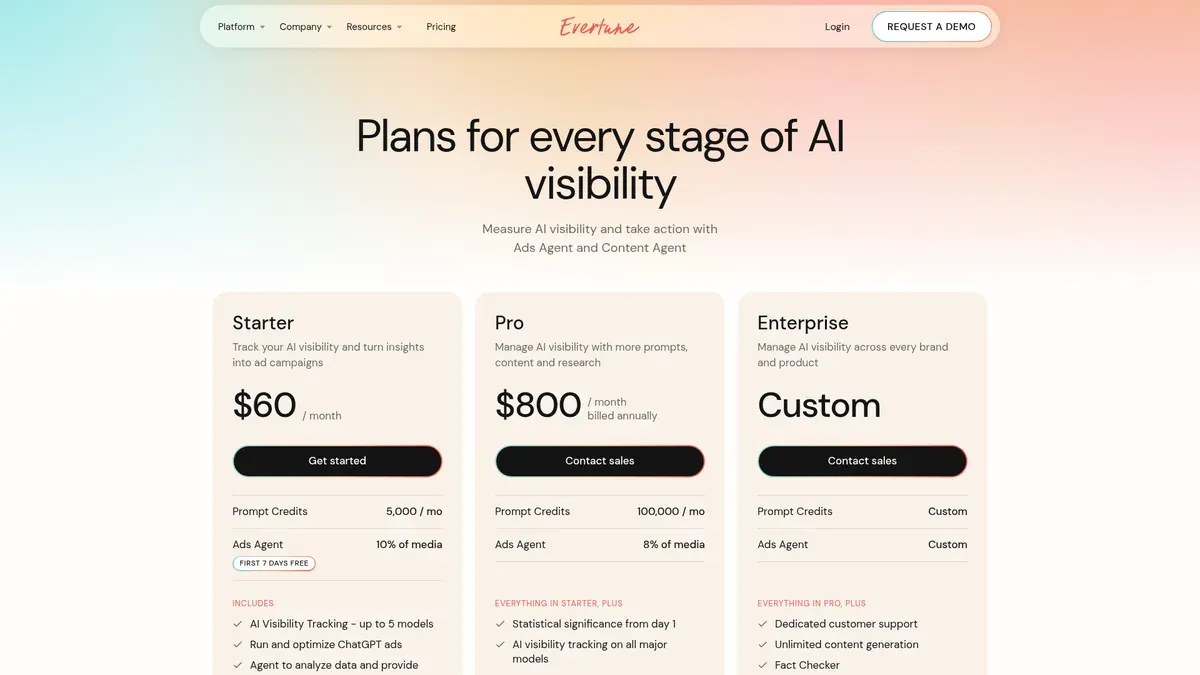
Here is what Evertune's pricing page showed when we reviewed it. Starter is listed at $60 a month, with 5,000 prompt credits a month and AI visibility tracking for up to five models. Pro is listed at $800 a month, billed annually, with 100,000 prompt credits a month. Enterprise is custom. Evertune's own pages do not fully agree with each other. A second pricing page labels Starter as billed annually and lists four models, so treat the $60 as the figure on the main pricing page and confirm it before you quote it to anyone.
You may also notice a "first 7 days free" label on the page. It is attached to Evertune's Ads Agent, and the plan comparison shows a seven-day trial for the Ads Manager Agent. Nothing we found shows a free trial of the AI visibility tracking product itself, so we are not counting it as one.
Evertune is the better fit when a marketing team wants the wider insight and activation product and is happy to evaluate it through its own signup or demo route. Our guide to free alternatives to paid AI visibility trackers covers what you keep and give up when you make that swap. For a consultant with one client and a small retainer, the question is simpler. You need ongoing tracking that does not cost anything before the client is paying, and that is where the next five entries come in.
Best for: freelancers who want to monitor a real client brand over time, cover its actual buyer questions, and are comfortable connecting their own provider key.
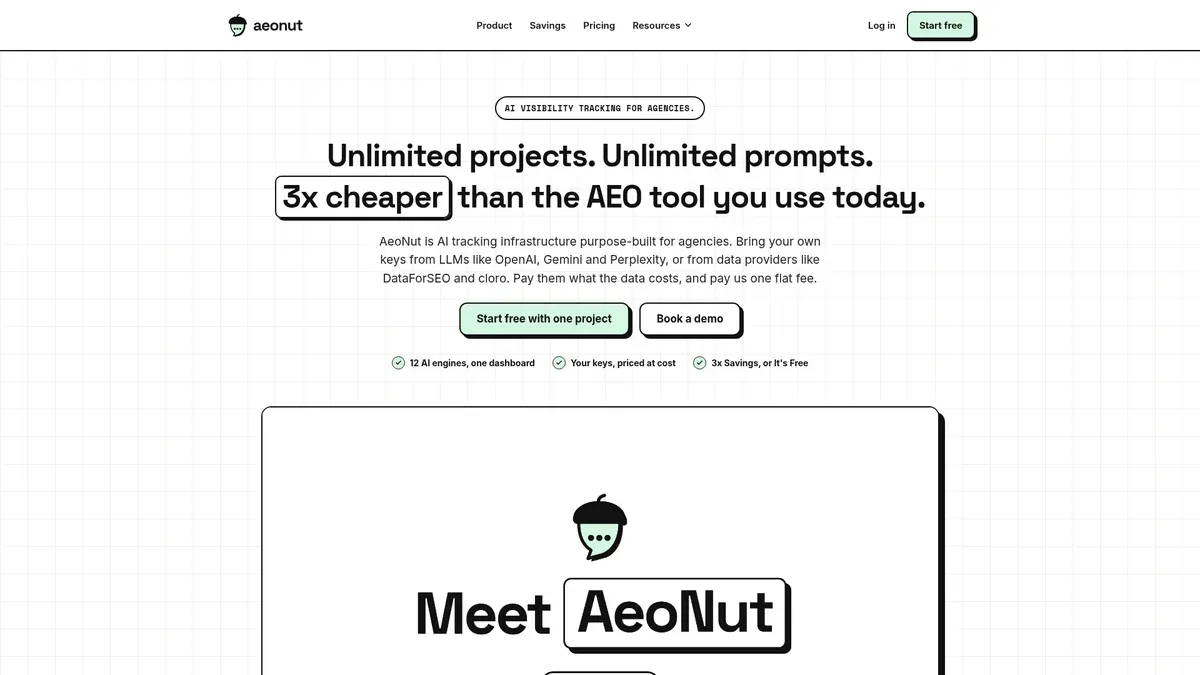
AeoNut is AI visibility tracking built for agencies, and the Free plan gives a single consultant the same product an agency uses. Each client brand is a project with its own prompts, competitors, engines, countries and schedule. Free holds one project, with no card and no time limit, so it is not a trial that runs out before you have anything to show. It also has unlimited prompts, which matters more than it sounds. You never have to decide which of the client's questions to leave out, so you can track the twenty or thirty questions their buyers really ask and then add the ones that name their main competitors. If you are not sure what to track, free AI prompt research tools can help you decide.
Every feature is on the Free plan, and plans differ only in how many client projects they hold. That includes white-label client reports with your branding on them, the read-only MCP server, the API and CSV export. Reports also export as PDF, Excel and Markdown. If a client has ever seen a vendor's logo on a report you sent, you know why that matters, and our guide to free AI visibility reporting tools covers the options for client updates.
Here is what you get, with AI brand analytics free of any platform fee, measured for the client. AeoNut records Mention rate, Cited, Avg. position in the answer, Share of voice against the competitors you track, and Sentiment, and it shows trends by engine, prompt and country. It also keeps the raw AI answer for each prompt, so when a number moves you can open the answer and see why. Share of voice is relative to the competitors you chose to track, and it is not a count of every answer on the internet.
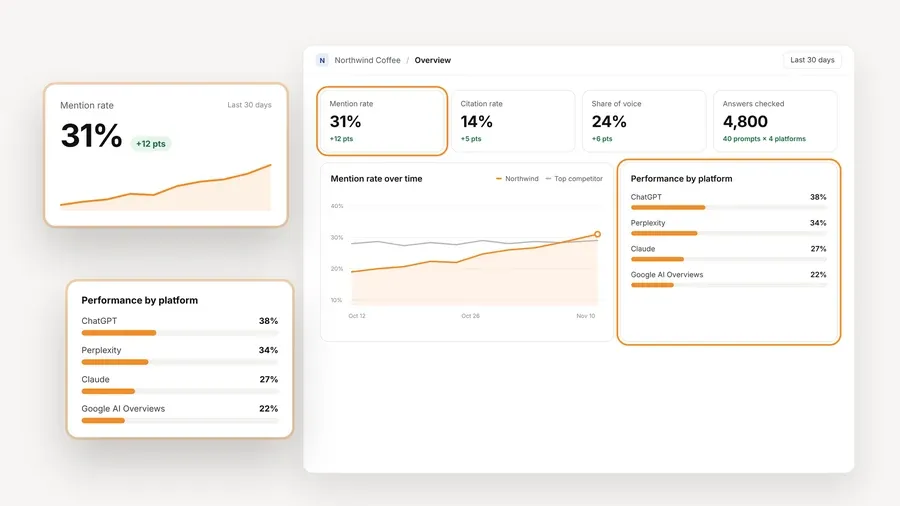
AeoNut tracks twelve engines: ChatGPT, Gemini, Perplexity, Claude, Grok, Google AI Overviews, Google AI Mode, Mistral, Meta AI, Qwen, Z.ai and MiniMax. For each engine you choose whether to use scraped data, which is the answer a real user sees in the ChatGPT, Gemini or Google app and the lowest-cost route, or API data, where you pick the exact model. You set how often it runs too, daily, twice a week or weekly.
The part that needs your attention is the data cost, so here it is plainly. The platform is free, and the AI answer data is billed by your own provider at its own price. AeoNut does not mark it up. Our guide to free trackers that use your own API keys explains the setup. You can connect a key from OpenAI, Anthropic, Gemini, Perplexity or DataForSEO, and one key from a single provider is enough to start. Before anything runs, AeoNut shows a cost preview, and you can set budget caps and alerts per client. Keys are encrypted at rest and never shown again after you save them, and AeoNut recommends restricted keys with spending limits and shows you how to set them up. For a sense of scale, the published example is 10 clients with 100 prompts each, tracked daily on ChatGPT, Perplexity and Google AI Overviews, which comes to about $135 a month in data. Your own cost depends on your prompts, engines and schedule, so use the preview and not that number.

Getting started does not involve a call. You sign up with Google or a work email, connect a key, create the client project, add prompts and competitors, choose engines and a schedule, check the cost preview and start tracking. A free setup call is available if you want one, but nothing waits on it.
Pricing: Free is $0 forever for 1 client project. Pro is $99 a month, or $79 a month billed annually, for up to 10 client projects. Unlimited is $499 a month, or $399 a month billed annually, for unlimited projects. Every plan has every feature.
One limit to know: Free holds one project. When you take on a second client, Pro is the next step, and it is still one flat fee for up to 10 projects, so the tracking bill does not grow with each new client.

Best for: someone who wants a hosted free plan with scheduled weekly checks and does not need many prompts.
Rankbits is the closest thing here to AeoNut in shape, because its free plan keeps running on a schedule. Free is $0 forever for one brand, with weekly tracking, five prompts per scan, five engines and search sources, and 100 AI responses a month. Those five sources are ChatGPT, Google AI Overview, Google Search, Bing Search and Perplexity, and not all of them are AI answer engines, so read the list as engines and search sources. API access is included on every plan after email verification. Free reports can be shared publicly, but exports start on the paid plans.
The paid tiers are Starter at $49 a month for 3 brands, 20 prompts per scan and 2,400 responses a month, and Pro at $99 a month with unlimited brands, 50 prompts and 5,000 responses a month. Extra response credits can be bought at $30 for 1,000.
One limit to know: the free allowance is tight. Five prompts and 100 responses a month cover a small first look, but they will not cover the real questions of one client. The pricing page we reviewed did not say whether a card is needed to create a free account, so check that yourself before you plan around it.

Best for: a consultant who needs a fast first look across several platforms before choosing prompts for ongoing tracking.
You type in a brand name and the checker looks at ChatGPT, Gemini, Perplexity, Microsoft Copilot, Google AI Overviews and Google AI Mode. There is no signup and no card, and there is no limit on how many brands you check. Ahrefs says the prompts are search-backed, meaning they come from real search behavior. The free result is a limited preview, with total AI mentions, mentions by platform, top topics and cited domains and pages, and the page describes a top-five preview for those sections.
It is a one-time snapshot. Ongoing monitoring is the paid Brand Radar, and the checker page shows two options, Select platforms at $199 a month and All platforms at $699 a month. Another Brand Radar page shows a different starting price, so treat those two figures as the ones shown on the checker page and confirm the current price before you quote it.
One limit to know: a snapshot cannot give you a trend, and the page does not say that free-checker results can be exported or shared. It is a good opening move in a prospect conversation, and it is not a substitute for tracking.

Best for: a prospect conversation where you want a scored, written diagnostic without creating an account.
You enter a company name, location, industry and product or service, and the grader asks three models, ChatGPT, Perplexity and Gemini, about the brand. The page says the result comes from what those models say about the brand from their training data, and it is ready in under two minutes. You get a score out of 100 across five parts: Sentiment Results (40 points), Presence Quality (20), Brand Recognition (20), AI Share of Voice (10) and Market Competition (10), along with a written interpretation.
HubSpot's ongoing product is HubSpot AEO, at $50 a month, and it does not require a HubSpot subscription. It is also included in Marketing Hub Pro and Enterprise.
One limit to know: this is a perception check from training data, and it is not live tracking of what the engines answer today. It does not predict traffic or sales, and the page we reviewed did not say whether the report can be exported or shared.

Best for: a consultant who wants a free report with competitive context in a shareable format and does not mind verifying an email.
The free report is built around 100 generated buyer questions, run on ChatGPT only. You enter a website and confirm your email with a six-digit code, and no payment details are needed. An agency can mark the report as being for a client and have it sent to a work email. It covers the share of tested answers that mention the brand, share of voice among the brands in those answers, sentiment, ranking, cited sites and pages, and a few readiness scores, plus three 30-day goals. The 100 questions are generated buyer questions, not questions pulled from real searches, so they carry no search-volume data.
Paid plans are separate. Brand Pro is $125 a month for 100 tracked prompts and one project, and the agency Launch plan is $250 a month for 5 projects. Both show a 14-day free trial, and the pricing pages do not say whether a card is needed to start it.
One limit to know: it is ChatGPT only, and it shows the answers on the day it ran. The same question can get a different answer later, so it works as a first look more than a way to report progress.
A recurring prompt tracker runs a set of prompts you chose, on engines you chose, again and again. What you get back is a history. For each prompt you can see the answer, whether the brand was mentioned or cited, where it appeared, which competitors showed up and how all of that moved over weeks. That history is what a client wants to see on a monthly call, and free AI search monitoring tools are worth a look for that reason.
A one-time checker answers another question, which is what its own test produced at the moment you ran it. Ahrefs gives a limited preview, HubSpot grades training-data perception, and Searchable runs 100 generated questions on ChatGPT. All three are fair ways to open a conversation. None of them gives you a line that goes up or down, which is the gap that moving from a one-time check closes, and their scores are not comparable with each other because the prompts, platforms and scoring differ.
Broader platforms such as Evertune add other layers, like prompt-volume insights and competitor intelligence, and they are priced for that wider scope. If you are not sure which kind of tool you need, our guide to free AI visibility tools by job walks through the choice. For readers who want to see how the label on the tool maps to what it does, free AEO, GEO and LLM tracking tools covers the naming.
Choose by what you need to show the client in the next month.
If you are weighing more than one client, the free plans stop at one project, so plan for Pro when the second client signs. The cost question follows you either way, and we compare how the free plans handle limits in free AI visibility plan limits compared.
If you want ongoing tracking for one client without a call, a card or a countdown, AeoNut's Free plan is the one to start with. Start free with AeoNut, connect a provider key, check the cost preview and add the client's real questions. A first trend takes a few weeks of runs, so starting this week is the practical move.
AeoNut's Free plan is a free-forever option for ongoing tracking of one client project, with unlimited prompts and every feature included. The platform fee is $0, and your AI data provider bills you for the answer data at its own price.
Yes. You can sign up with Google or a work email, and no card is needed. A free setup call is offered if you want help, but the self-service route does not depend on it.
No. The Evertune pages we reviewed show a direct signup for the Starter tier as well as a request-a-demo option. Its listed Starter tier is paid, and the pricing page we reviewed did not show a permanent free plan.
No. The Ahrefs checker, the HubSpot grader and the Searchable free report are one-time snapshots or diagnostics. A tracker reruns your chosen prompts on a schedule so you can compare results over time, and since each tool uses different prompts and scoring, you should not treat their scores as the same measure.
Tools & Comparisons ·
Compare free tools that report citation rate and brand mention rate as separate numbers, and see which are ongoing plans and which are one-time checkers.

Tools & Comparisons ·
Is a self-hosted AI visibility tracker worth your time? Compare setup, upkeep, data control and engine coverage with a managed free plan before you decide.

Tools & Comparisons ·
Which free AEO tracking tool keeps running, saves history and shows change? Compare five free options on schedule, trends and alerts to pick one for a client.