
Tools & Comparisons ·
Free Tools That Track Citations and Brand Mentions Separately
Compare free tools that report citation rate and brand mention rate as separate numbers, and see which are ongoing plans and which are one-time checkers.
Want a free Mentionable alternative? Keep citations, sentiment and competitor share for one client, free forever, and compare three lighter free options.
Avinash Saurabh · · 18 min read
If you're a freelance consultant and a client has just asked whether they show up in ChatGPT, you probably want a free Mentionable alternative that keeps your options open. You don't want to sign up for a monthly platform subscription before the client has paid you for anything. That's a fair thing to want, and there are a few good ways to get it.
First, a correction to the title's framing, since it affects how you should shop. Mentionable is not a mention-only tracker. Its current pricing, features and dashboard pages describe citation rate, sentiment, competitor share of voice, average position, source tracking, performance over time and the full text of individual AI answers. So the question isn't which tool adds those measurements. The question is how to keep that depth, and the history behind it, without taking on a recurring platform fee for your first client.
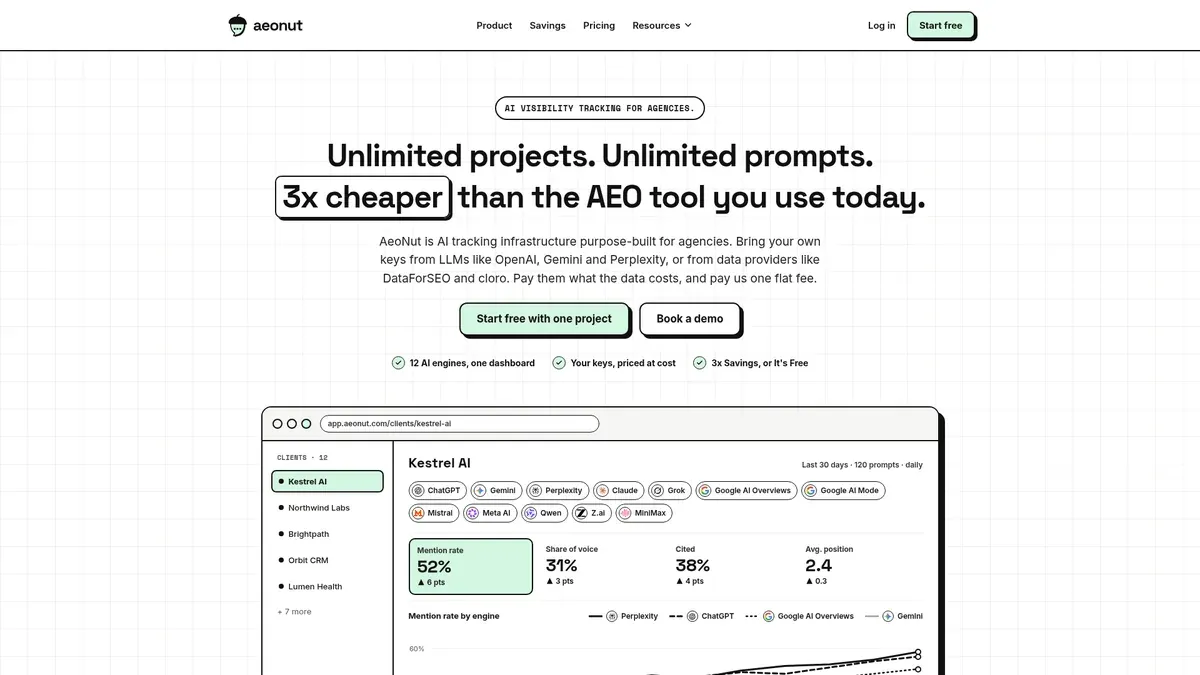
The short answer is AeoNut. Its Free plan tracks one client brand, free forever with no card, with unlimited prompts, mentions, citations, Sentiment, Avg. position, competitor Share of voice, trends and white-label client reports. Free forever. Unlimited prompts. Your own keys. The platform costs nothing, and the AI answer data is billed by your own provider at its price, with an estimate shown before anything runs.
This guide covers four picks and a short baseline of what Mentionable itself offers, so you can see what you'd be replacing. It is based on each vendor's public pages as of November 2026, not on hands-on testing or an accuracy benchmark.
A free tool can mean very different things, so each pick is judged on the same seven points.
These are fit criteria, not a measured performance test. If you're hunting for a lightweight AI mention tracker alternative, the table below shows where each option lands. Vendors also call this job AEO, GEO or LLM tracking, and which label means which tool sorts that out.
| Pick | Best for | What is free | Beyond mentions | Ongoing tracking | Main decision boundary |
|---|---|---|---|---|---|
| 1. AeoNut | One hosted client project with continuing measurement and branded reports | Platform free forever for one client project, unlimited prompts, no card | Citations, Sentiment, Avg. position, competitor Share of voice, sources, trends | Yes, scoped per project with its own schedule | You bring a provider key and pay the provider for data, with a cost preview and budget caps |
| 2. Vigie | Technical consultants who want local, open-source analysis | MIT-licensed local software, no subscription | Source rate, competitor share, average position, history, optional AI sentiment reading | Daily or weekly while open, or through CLI scheduling | Local setup, and Google AI Overviews and AI Mode are on its roadmap, not current native engines |
| 3. Ahrefs Free AI Visibility Checker | A quick, no-account check for a prospect or brand | Free checks, no card, top-five previews | Cited domains, cited pages, topics, platform breakdown | No, a one-time snapshot | History, custom prompts and competitor monitoring sit in a separate paid product |
| 4. Searchable Free Visibility Report | A shareable first-conversation report | Free report, no card | Competitor share of voice, sentiment, brand facts | Not promised on the free-report page | A report, with recurring entitlements and some engine scope not fully specified |
Before comparing tools, it helps to know what each extra measurement tells you, because that's what you're choosing to keep.
Mentions and citations answer different questions. A mention means an AI answer names a brand. A citation means the answer links to a source. They can happen separately. An answer can recommend your client while citing an independent review instead of the client's own site, and it can cite the client's page without recommending the brand at all. So you check two things: was the brand named, and was its own website cited, along with which other sources backed the answer. Source analysis adds a third layer, the domains and pages an engine leans on, whether they belong to the client, a competitor or a publication.
Sentiment adds interpretation. A mention can be positive, neutral or negative, and a count alone can't tell a recommendation from a warning. Automated sentiment is a model's classification, not a verified statement of customer opinion, so the raw answer is worth reading next to the label.
Position adds prominence. Average position describes where the brand shows up in an answer or a recommendation list. It isn't a Google ranking or a traffic number, and each product has its own counting rules, especially for answers that don't mention the brand at all.
Share of voice adds a competitive denominator. Mention rate is the share of tested answers that name your brand. Share of voice compares you with the competitors you track. As an illustration only, not any vendor's result: say 10 tested answers name a brand six times, so its mention rate is 60%. If those answers hold 20 mentions across the brand and its tracked competitors, its mention-based share of voice is 30%. If its own site is linked in three of the 10 answers, an all-answer citation rate is 30%. Vendors use different denominators and counting rules, so treat this as a way to think, not as a formula every tool follows.
Trends add continuity. A snapshot tells you what one check found. A trend tells you what changed across repeated checks. AI outputs vary with the engine, model, country, prompt wording and web-search availability, so a change after you edit the prompt set isn't necessarily a change in the client's visibility. That's a good reason to keep the prompt set steady, and free AI search monitoring tools that keep your history help with that. If you want to go deeper on any one of these, the guides on free citation source analysis and free brand sentiment tracking take one measurement each.
Here is the baseline, kept short and fair. Mentionable is a good fit for a buyer who wants paid daily AI visibility tracking bundled with broader site and content work, prepared onboarding and reporting integrations.
All prices below are in euros and exclude VAT, as shown on its pricing page in November 2026.
| Tier | Price | Tracking scope |
|---|---|---|
| Presence | €249 a month | 50 tracked questions, three selected AI engines, one country, up to 150 answers analyzed per day |
| Influence | €449 a month | 100 tracked questions, four selected AI engines, two countries, up to 400 answers analyzed per day |
| Reference | €799 a month | 150 tracked questions, all supported AI engines, three countries, up to 900 answers analyzed per day |
| Custom | Quote required | More questions and countries, several brands on one account, or a managed arrangement |
| Free trial | Free for seven days | No credit card, starts on Presence |
Mentionable tracks ChatGPT, Claude, Perplexity, Gemini, Google AI Mode and Google AI Overview, and you choose engines up to your plan's allowance. It documents daily tracking, mention and citation rate, sentiment, competitors and share of voice, average position in its API metrics, source tracking and the full text of answers. API, MCP and Looker Studio access are in every plan, including during the trial. Onboarding starts from your website and a conversation about your business, offers, countries and competitors, and it prepares customer questions from that.
The honest boundary is commitment and fixed allowances. After the seven-day trial there is no permanent free tracking plan on the pricing page, and the question, country and engine allowances are set per tier. If you need ChatGPT, Gemini, Perplexity, Google AI Overviews and AI Mode all in one scope, the three and four engine allowances on Presence and Influence don't cover those five surfaces, so Reference is the published tier with all-engine access. That's what a consultant with one client and no retainer yet is really weighing, and it has nothing to do with whether the analytics are good.
Best for: a freelancer who wants a hosted, continuing tracker for one client brand, with broad analytics and reports under their own name.
AeoNut's Free plan takes away the platform subscription for one project and keeps the analytics and reporting that make the work useful to a client. It is the only AI visibility tracker that is free forever with unlimited prompts, which is the full wording that holds up when you check other tools: some have credit-capped free plans, and several offer free one-off checkers or graders, which aren't ongoing tracking.
Each client is its own project, with its own brand, competitors, prompts, countries, engines and schedule. For that project AeoNut measures Mention rate, Cited, Avg. position, Share of voice against the competitors you track, and Sentiment, with trends by engine, prompt and country. It also keeps the raw AI answer for every prompt, the sources cited, the client's own cited pages, each competitor's cited pages, a competitor leaderboard and breakdowns by prompt category.
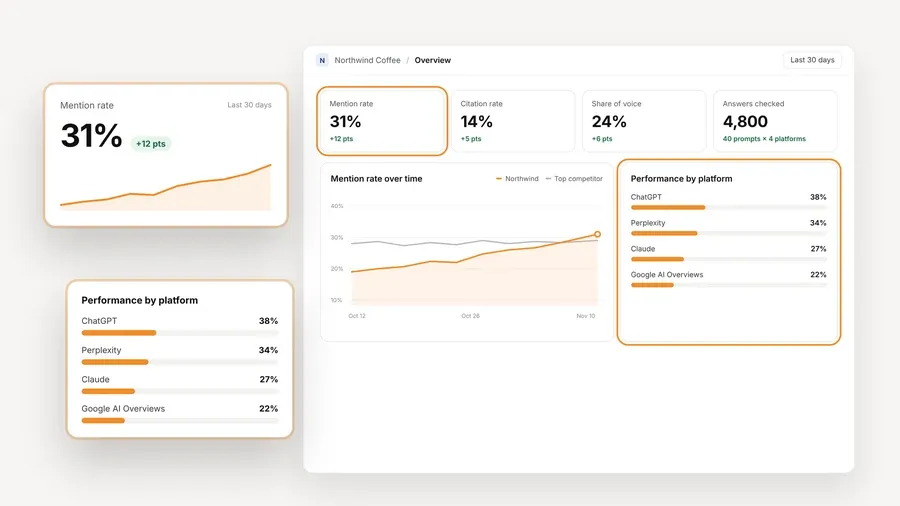
AeoNut tracks twelve engines: ChatGPT, Gemini, Perplexity, Claude, Grok, Google AI Overviews, Google AI Mode, Mistral, Meta AI, Qwen, Z.ai and MiniMax. Every one of them is part of the plan. That's plan access, though, and not a promise that a single provider key covers all twelve. You connect the providers for the engines you choose, and one key from a supported provider is enough to start. Supported key providers are OpenAI, Anthropic, Gemini, Perplexity and DataForSEO.
You set the scope per client. You pick the engines, the countries and how often it runs (daily, twice a week or weekly), and for each engine whether to use scraped data, which is the answer people see in the consumer apps, or API data from a specific model.
White-label client reports are included on Free. Reports and shareable links carry your branding, not AeoNut's, and they export as PDF, Excel and Markdown, with CSV export for raw data.

The MCP server lets Claude, Cursor, VS Code and other MCP clients read your workspace's visibility data, and a read-only REST API offers another route for scripts and dashboards, with free reads at 120 requests a minute per workspace. You don't need either to get value from the basic tracking, and Mentionable already includes its own API and MCP, so this isn't something only AeoNut has. What's different is that you get these on a free one-project plan.
Free describes the platform, not the AI requests. You bring a provider key and pay that provider directly, with no AeoNut markup. AeoNut shows an estimated cost before tracking runs and offers spend per client, budget caps and alerts. So this isn't zero setup, and the total bill isn't guaranteed to be zero. What you get is visibility into a variable cost instead of a hidden prompt allowance.
For scale, the published example is about $135 a month in data for 10 clients with 100 prompts each, tracked daily on ChatGPT, Perplexity and Google AI Overview. That is a vendor estimate for that exact workload, not a quote for one free project and not a comparison with Mentionable.
One project is the limit on Free, and free tracking by reader and industry shows which setups fit a freelancer. If you pick up more clients, Pro is $99 a month ($79 a month billed annually) for up to 10 client projects, and Unlimited is $499 a month ($399 a month billed annually) for unlimited projects. Every plan includes every feature, so you don't change tools, and a Done-For-You Switch can import prompts, competitors and tracking history from another tool. The comparison with other free offers by type is worth a read if you want to see where each kind of free fits.
AeoNut ranks first here because it matches the combination this reader needs: a persistent hosted project, unlimited prompts, the engines clients ask about, deeper analytics, client branding and cost visibility. That's a fit-based call, not a claim that it wins every use case.

Best for: a consultant comfortable installing software who wants local project storage, inspectable open-source code and repeatable API-based analysis without a software subscription.
Vigie is MIT-licensed local software with no account or subscription. You bring your own API keys, and the AI provider charges apply as they would anywhere. The reviewed README documents no paid software tier and no explicit prompt, competitor or project cap. That is not the same as a hosted promise of unlimited capacity, but it does mean no software fee gets in your way.
It reports an AI visibility score, mention rate, share of voice, average position, source rate, coverage and trends. An optional extra AI-reading step judges sentiment and spots brands you haven't added yet. Source rate is the share of sourced answers that cite the brand's website, so don't compare it directly with an all-answer citation rate without checking the denominator. Analyses are kept, and adding a competitor makes Vigie reread past analyses automatically. PDF reports include charts, prompt tables, sources and methodology, and CSV exports cover prompts, competitors, sources and full answers, with JSON for the full dataset.
Native engines are ChatGPT through OpenAI, Claude through Anthropic, Gemini and Perplexity, with web search on, and OpenAI-compatible endpoints can add other providers or local models. Google AI Overviews and Google AI Mode are on the roadmap rather than documented as current native engines, and adding a compatible model doesn't make it the same as tracking Google's own interfaces.
Setup means Node.js 20.3 or newer, a downloaded repository or Git clone, then npm install and npm start, with the browser interface running locally on port 4100. You enter a brand, its website, competitors and prompts, and the README suggests about 10 to 30 prompts for a useful first picture, which is the project's recommendation and not a validated threshold. Daily or weekly scheduling works while Vigie is open, and the CLI can be scheduled through cron. If you'd rather not keep it running, see free rank tracking that runs daily.
The limitation is the same thing as the strength. Running locally means you maintain the installation, the machine and the files, rather than getting an always-hosted workflow. Projects, analyses and API keys are stored as plain JSON files, and local doesn't mean nothing leaves your computer, because prompts still go to the providers you select. Custom PDF logos and colors are on the roadmap, so the current PDF output isn't white-label. On cost, requests equal prompts times engines times repetitions, so 20 prompts on four engines is 80 requests, and the optional reading doubles that. Choose it when local control matters more than hosted convenience or native Google coverage. For a fuller view of engine coverage, see the guide on per-engine checkers versus one tracker.

Best for: a consultant who needs an initial check with no account, provider key or card.
Ahrefs offers its checker free, with no signup, no card and no published limit on how many brands you check. It reports total AI mentions, a platform breakdown, associated topics, cited domains and cited pages, which is more context than a yes or no. Ahrefs says it uses search-backed prompts derived from real search behavior, which is a useful difference from a panel you wrote yourself, though that's a vendor description and not proof of better accuracy for every client.
The free output shows the top five topics, top five cited domains and top five cited pages. The current FAQ lists six surfaces, ChatGPT, Gemini, Perplexity, Microsoft Copilot, Google AI Overviews and AI Mode, though the page's intro copy names five and leaves out AI Mode. Don't assume identical prompt sampling across every surface.
Ahrefs calls the checker a one-time snapshot. Historical monitoring, AI share of voice, competitive benchmarking and custom-prompt tracking belong to its separate paid Brand Radar product, so don't count sentiment, scheduled prompts, white-label reports or API access as part of the free tool.
The real advantage is the lack of setup. The limit is the snapshot format and the preview size. It's a better choice than configuring a tracker when the job is one prospect conversation, and it isn't a replacement for a monthly client trend report.
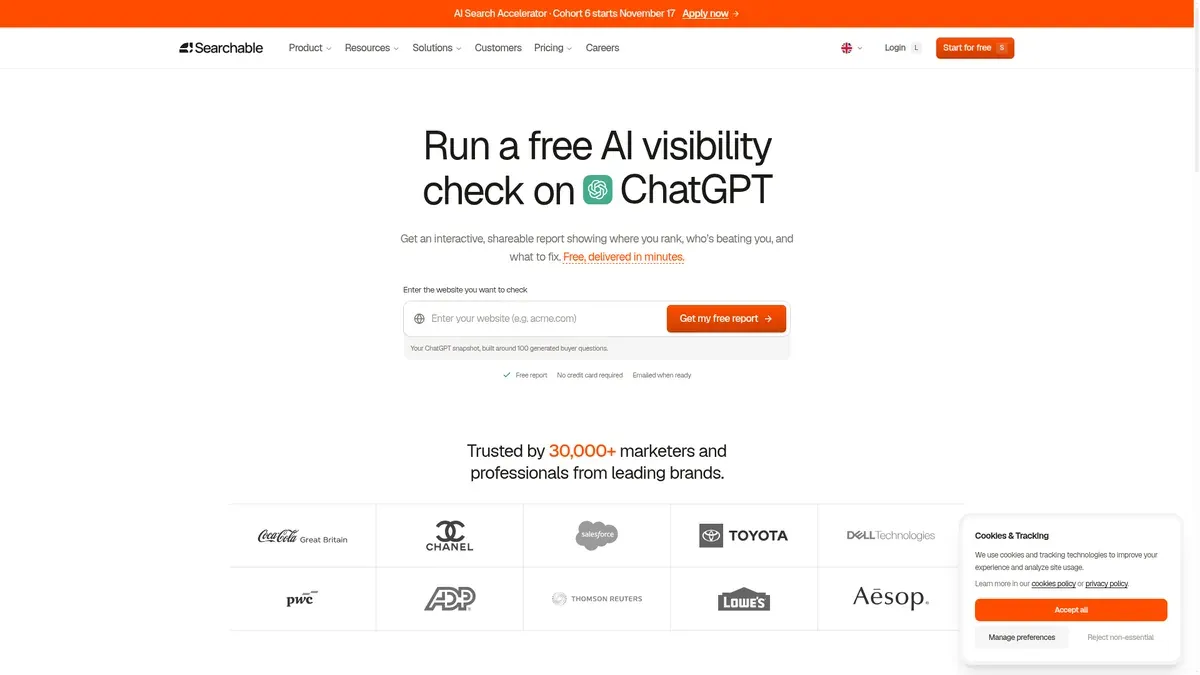
Best for: a consultant who wants a first-conversation report with competitor context, sentiment and brand facts instead of a bare count.
The report is free with no credit card, and the page advertises delivery in minutes. It describes an interactive, shareable report with a visibility score benchmarked against thousands of tracked brands, competitor analysis and share of voice, prompts that mention competitors but not your brand, and sentiment and brand facts, meaning what AI says about you and which facts it surfaces.
Engine scope needs care. The offer heading names ChatGPT, Google and Perplexity, and the score description names ChatGPT. The page doesn't say whether "Google" means AI Overviews, AI Mode or both, so don't promise that to a client. The reviewed page also doesn't establish a continuing free tracking schedule, unlimited custom prompts, white-label output, PDF or CSV export or API access. "No credit card" is supported, but "no signup" and "free forever monitoring" are not.
Its strength is packaging competitor and sentiment context into something you can share. The limit is that ongoing tracking isn't documented as part of the free report, so it isn't the controlled, continuing prompt panel an engagement needs. Choose it when the report is the deliverable. For a side-by-side with another option, the guide on a free Searchable alternative goes further.
Match the pick to the job in front of you, and free tools by tracking job covers jobs beyond these four.
"Free forever" describes a plan as it stands today and isn't a promise that any vendor can never change its terms. Export options and documented migration paths are a better protection than any promise, so check them before you build a client's tracking on top of one.
Start free with one client project. Track unlimited prompts, keep the reporting depth, and see the provider data estimate before tracking runs. Start free with AeoNut, and if you want a hand, a free setup call comes with every plan.
AeoNut offers a free-forever platform for one client project, with unlimited prompts, citations, Sentiment, Avg. position, competitor Share of voice, trends and white-label client reports. You bring a provider key and pay the provider for AI answer data. Mentionable also measures beyond mentions, so the comparison is about free-plan fit and scope, not a missing category of analytics.
The current pricing page offers a seven-day trial with no credit card, starting on Presence. It doesn't publish a permanent free tracking plan. If you continue on Presence after the trial, it is €249 a month excluding VAT.
Yes, with limits. The Ahrefs checker and Searchable's report are free without a card for the diagnostic offers they describe. AeoNut's platform and Vigie's local software are free, but the AI provider requests behind them can cost money. An AI mention tracker free of subscription fees still has data costs, so free software doesn't mean free data.
Check whether the client's website is cited, which other domains and pages support the answer, how the brand is described, where it appears and how it compares with tracked competitors. For ongoing reporting, keep the prompt and engine scope consistent and read the raw answers along with the summary numbers.
Tools & Comparisons ·
Compare free tools that report citation rate and brand mention rate as separate numbers, and see which are ongoing plans and which are one-time checkers.

Tools & Comparisons ·
Is a self-hosted AI visibility tracker worth your time? Compare setup, upkeep, data control and engine coverage with a managed free plan before you decide.

Tools & Comparisons ·
Which free AEO tracking tool keeps running, saves history and shows change? Compare five free options on schedule, trends and alerts to pick one for a client.