Tools & Comparisons ·
Free Tools That Track Citations and Brand Mentions Separately
Compare free tools that report citation rate and brand mention rate as separate numbers, and see which are ongoing plans and which are one-time checkers.
Need AI visibility data without booking a demo? Compare six free options, from ongoing client tracking to one-time checkers, and see which one fits you.
Avinash Saurabh · · 15 min read
If a client has asked whether they show up in ChatGPT and you went looking at BrightEdge, you probably landed on a page that ends with a button to request a demo. That is fine for a team buying an enterprise SEO platform. It is a lot less fine when you are a freelance consultant who only wants to see how AI answers mention one brand, and you would rather not book a call to find out what that costs. This guide is a free BrightEdge alternative for exactly that case: a short list of ways to get AI visibility data without a sales conversation, with the one that tracks ongoing results listed first.
Here is how the six options were ranked. We looked at six things, in this order:
One note before we start. This is about replacing BrightEdge's AI visibility reporting only. We are not reviewing its wider SEO, content or reporting suite, and if you rely on that suite, nothing here is a reason to leave it.
If you want ongoing tracking for one client, with room for as many prompts as you want, AeoNut's Free plan is the closest fit. It is free forever for one client project, with unlimited prompts, every feature, and no card. The platform is free, and the AI answer data is billed by your own provider at its price, with a cost preview shown before anything runs.
If you only need a one-time look for a prospect call, the free checkers further down are quick and need no sales call either. They give you a snapshot, though, not a trend.
| Rank | Tool | Best for | Free access | What to watch |
|---|---|---|---|---|
| 1 | AeoNut | Ongoing tracking for a real client, with many prompts and client reports | Free forever, 1 client project, unlimited prompts, no card | Platform is $0, data is billed by your provider |
| 2 | Mangools AI Search Watcher | A small weekly monitor | Free plan, 1 monitor, 5 prompts, weekly checks | Pauses after 28 days without opening the dashboard |
| 3 | Semrush AI Search Visibility Checker | Fast spot checks | 3 free checks a day, no account | A snapshot, not the paid Toolkit's tracking |
| 4 | Ahrefs AI Visibility Checker | Checking many brands quickly | No signup, no card, no stated brand limit | One-time, top 5 results per section only |
| 5 | HubSpot AI Search Grader | A quick brand-perception read | Free one-time check, no account | Based on training data, not prompt-level tracking |
| 6 | SearchEye free report | A category audit from live answers | Free report, no card or trial | Needs a working email, a report and not a monitor |
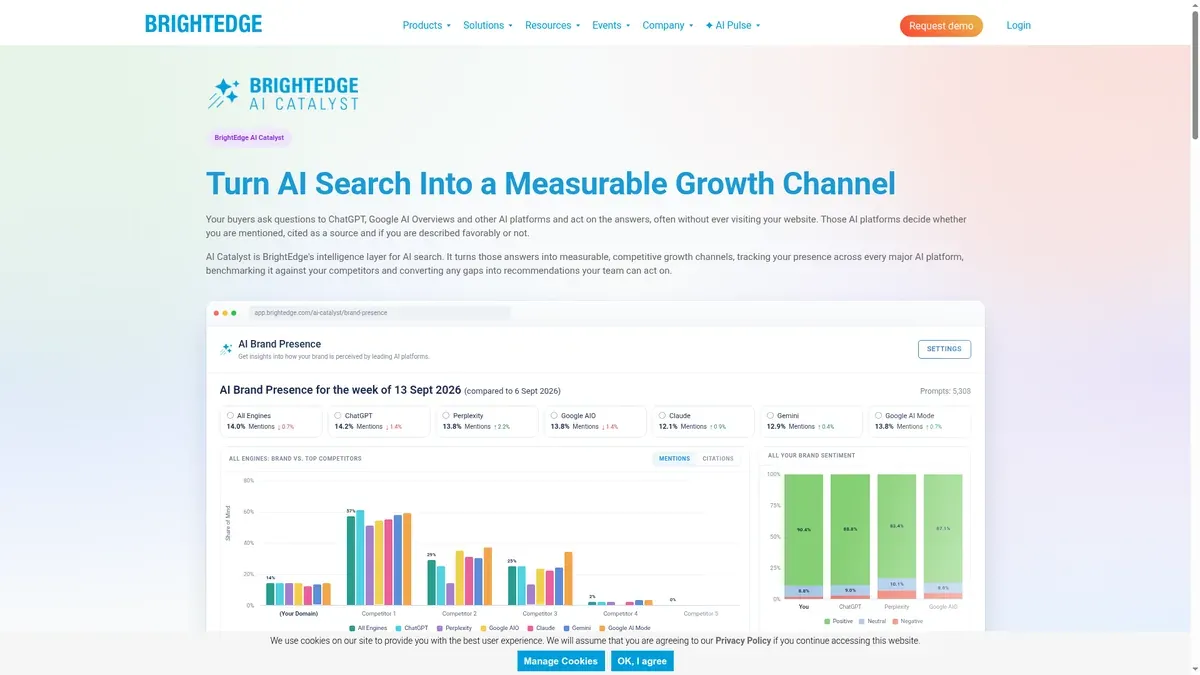
BrightEdge's AI visibility reporting product is called AI Catalyst, and it is the thing this guide treats as the benchmark. Its product page names ChatGPT, Perplexity, Google AI Overviews, Google AI Mode, Gemini and Claude, and mentions other AI platforms without listing them. Reporting covers mentions, citations, share of mind, sentiment, brand presence over time and competitor comparisons by engine. A Prompt Intelligence feature maps buyer prompts to buyer stages, and an AI Recommendations feature compares your page with pages the AI cites. Charts export as PNG and tables as CSV.
Here is the part that matters for this article. On the pages we reviewed, AI Catalyst and the related AI Hyper Cube product send you to a demo request. The demo page describes a call about your business, goals and competitors, and asks for contact details including a phone number. We did not find a public price list, a free plan, trial terms, usage limits or a self-serve signup. That is why people go looking for a BrightEdge alternative no sales call required, and it is a fair thing to want.
It helps to be careful about what that does and does not prove. It does not prove BrightEdge has no free access anywhere. A BrightEdge press release from April 2025 said AI Catalyst was available to all customers, which is not the same as saying it is free. ## Do you need the whole suite, or only the AI visibility reporting?
This is the question that decides everything else, so it is worth a few minutes before you compare tools. BrightEdge sells an enterprise SEO platform, and AI visibility reporting is one part of it. If your clients run on that platform, with content, SEO and reporting all in one place, the AI reporting is probably worth keeping where it is, because the value is in the connection between the pieces.
If you are a consultant who only wants to know how AI answers talk about one brand, the suite is more than you need. You are looking for a BrightEdge alternative for AI search that does one job: run a set of prompts on the engines your client's buyers use, record whether the brand is mentioned and cited, and show how that changes. A good test is to write down the three things you would show a client each month. If they are mentions, citations, share of voice against competitors and the sources the AI cites, a tracker covers it. If they also depend on enterprise SEO data, keep the suite and treat the tools below as a way to start earlier.
If you already use BrightEdge, ask your account contact what your plan includes. If you do not, the options below let you start on your own today.
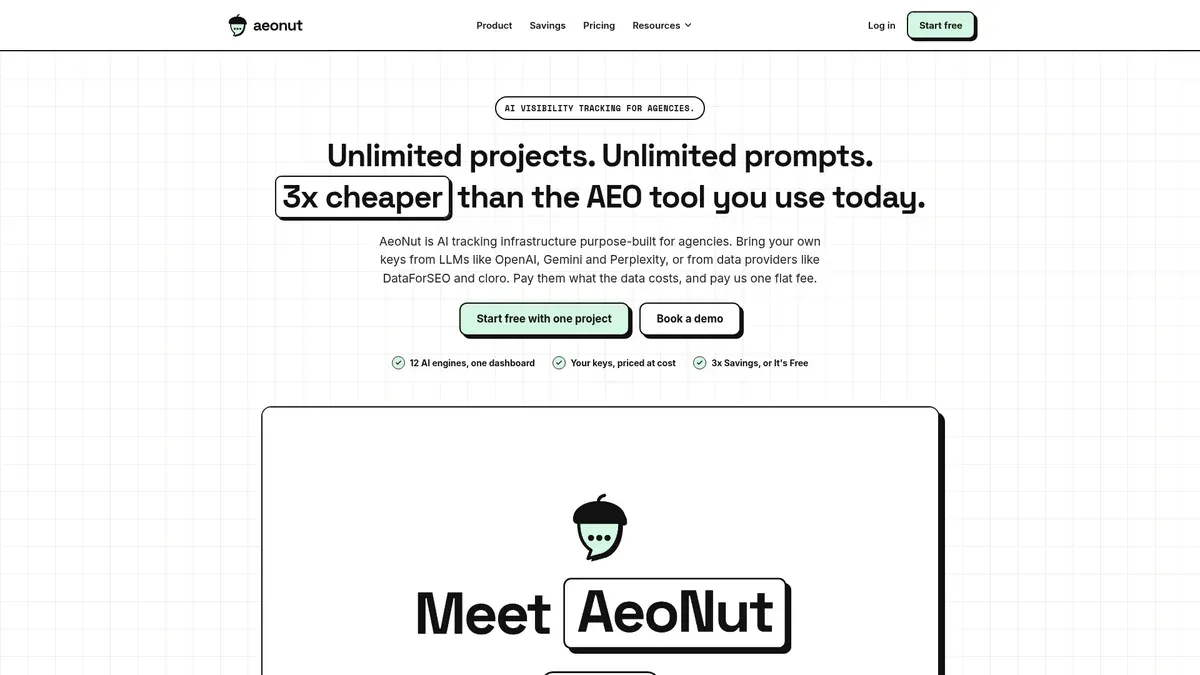
Best for: freelance consultants and small agencies who want to track one real client over time, with plenty of prompts, and start without a card or a call.
AeoNut is AI visibility tracking built for agencies. Each client brand is a project with its own prompts, competitors, engines, countries and schedule. AeoNut runs those prompts on the AI engines and records whether the brand is mentioned and cited, where it shows up in the answer and which sources get cited. The Free plan gives you one client project, and that is enough to track a real client properly or a prospect you are trying to win. It is free forever, it has unlimited prompts, and every feature is included, so you are not working with a cut-down version.
That matters for this reader in a few specific ways. A consultant does not usually need hundreds of prompts. They need the right twenty or thirty questions a client's buyers ask, plus a few that name the client's main competitors, tracked every week so there is a trend to show. With unlimited prompts you never have to pick which question to drop. You can track on twelve engines: ChatGPT, Gemini, Perplexity, Claude, Grok, Google AI Overviews, Google AI Mode, Mistral, Meta AI, Qwen, Z.ai and MiniMax. For each project you choose the engines, the countries and how often it runs (daily, twice a week or weekly), and for each engine you can pick scraped data, which is the answer a real user sees in the app and the lowest cost, or API data for an exact model.
Analytics cover Mention rate, Cited, Avg. position, Share of voice and Sentiment, with trends by engine, prompt and country. You also get a competitor leaderboard, the pages and sources the AI cites, and the raw answer for every prompt, so you can read what the AI actually said instead of trusting a score.
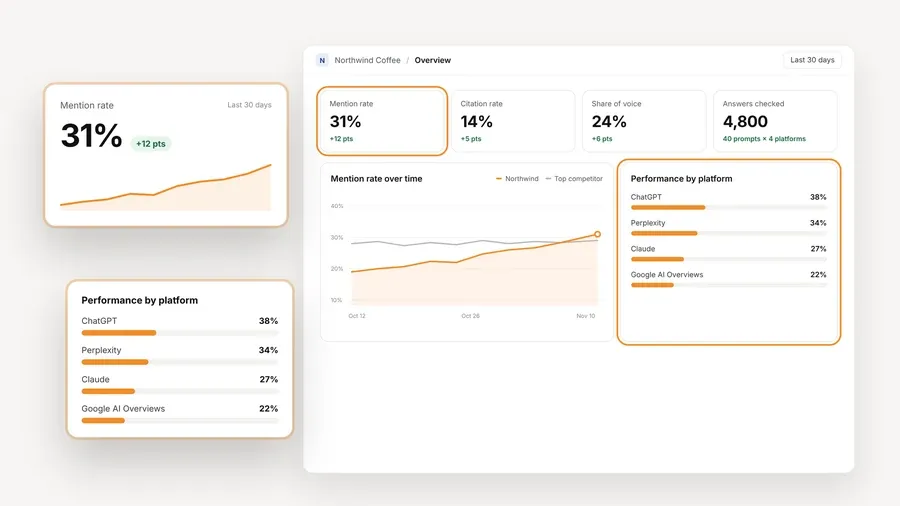
When you need something to send a client, the white-label client reports and shareable links carry your branding, not ours. They export as PDF, Excel and Markdown, and CSV export is available too. Free includes the same read-only MCP server and API as the paid plans, so an assistant like Claude can read the data and help you write the monthly summary.

Now the part about money, stated plainly. The platform is free. The AI answer data is not, because you bring your own key from OpenAI, Anthropic, Gemini, Perplexity or DataForSEO, and that provider bills you directly at its own price. AeoNut does not mark it up. One key from one provider is enough to start. You see a cost preview before tracking runs, you can set budget caps and alerts, and we recommend restricted keys with spending limits so there are no surprises. For scale, the site's own example is about $135 a month in data for ten clients with 100 prompts each, checked daily on ChatGPT, Perplexity and Google AI Overview. That is a ten-client workload, so a single client on a lighter schedule will cost much less.
The Free plan holds one client project. If you take on a second client, Pro is $99 a month ($79 a month billed annually) for up to 10 client projects, and Unlimited is $499 a month ($399 billed annually) for no cap. Every plan has every feature, so moving up only changes how many projects you hold. Setting up a key is a step you do once, and the setup takes you from a new project to tracking in four steps.
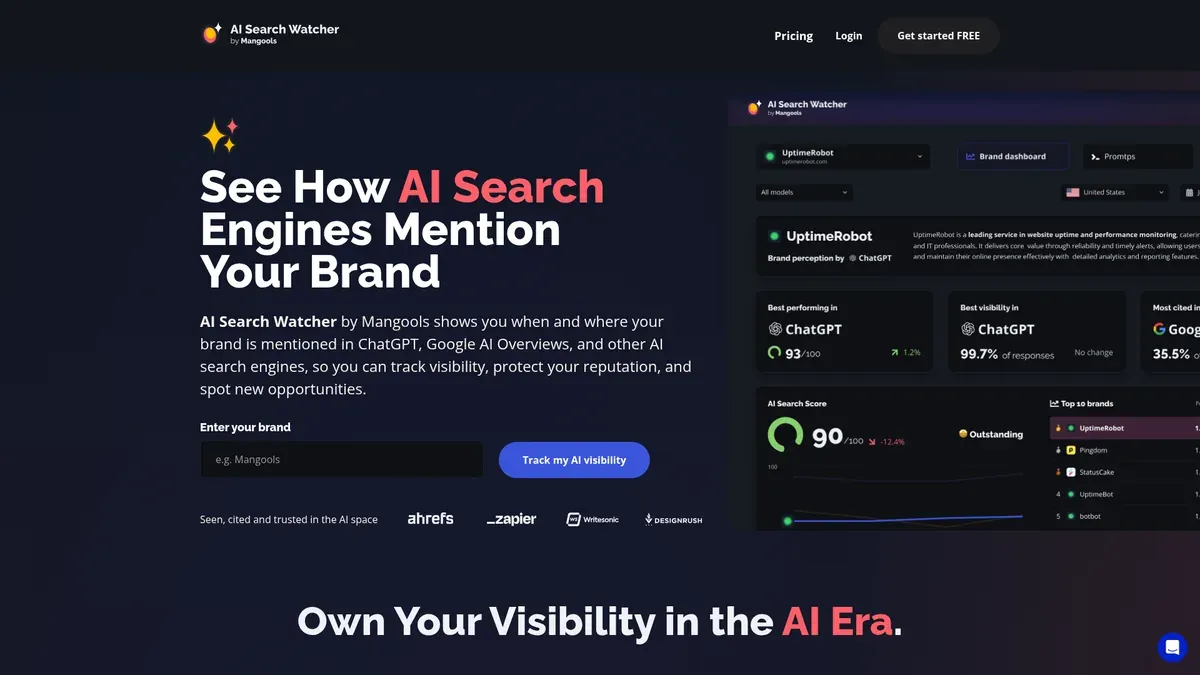
Best for: a consultant who wants a real weekly monitor for a small set of questions and can live with five prompts.
AI Search Watcher checks a brand, site, location and language against the AI models you select, once a week. The Free allowance is one monitor and five prompts. Location and language are fixed when you create the monitor, so a different country means another monitor. It runs each prompt twice, because answers can change between runs. The documented models include ChatGPT Search, Google AI Overviews, Google AI Mode, Gemini, Grok, Claude, Llama and Mistral, and Mangools says the list in the app is the one to rely on.
The dashboard reports position, visibility, a 0 to 100 AI Search Score, citations and citation rank. Competitors that show up in answers appear in a Top 10 brands table, but there is no field to add a competitor to a monitor, so following one closely means creating another monitor and spending its prompts.
The catch for a hands-off consultant is the inactivity rule. Mangools sends a warning after 21 days without a dashboard visit and pauses monitoring after 28. Your history and prompts stay, and you can reactivate, so it is real ongoing tracking, just not set and forget. Five prompts is also a smaller scope than most client questions need. It suits a tight, simple brand. For a client with a long list of buyer questions, you will outgrow it quickly.
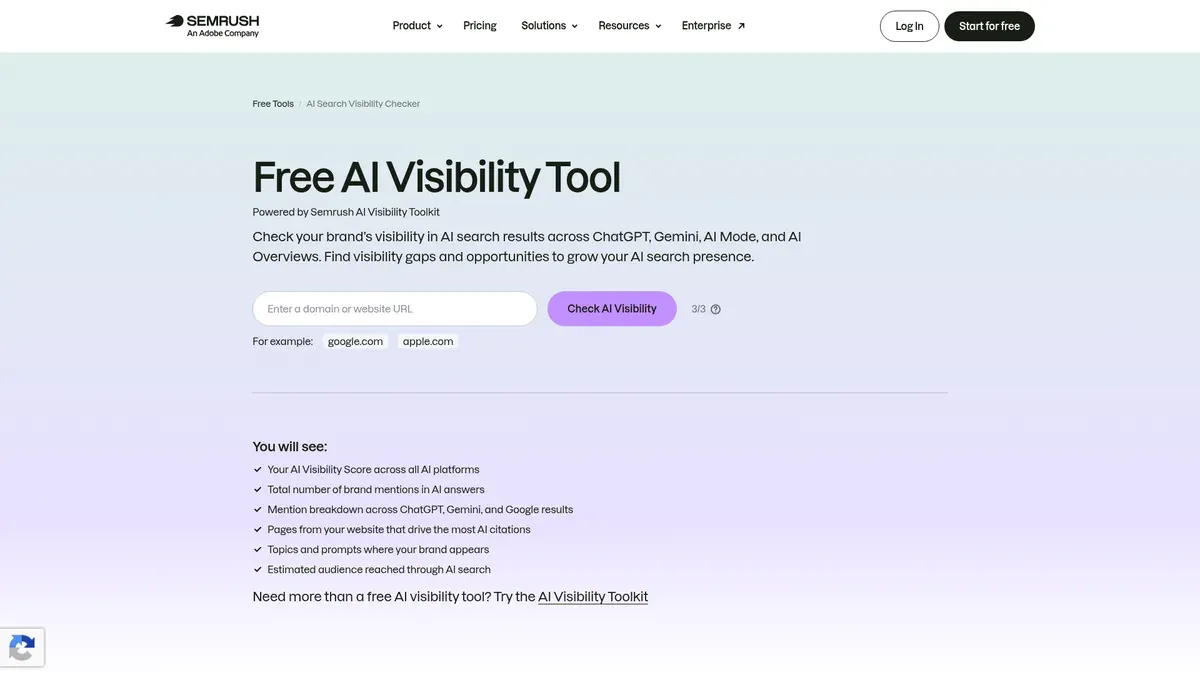
Best for: quick, repeatable checks when you do not want to create an account.
You enter a domain, and the free checker covers ChatGPT, Gemini, Google AI Overviews and Google AI Mode. Semrush says you can use it three times a day without registering. The report shows an AI Visibility Score, mentions, a platform breakdown, audience reach, top cited pages, topics and a competitor comparison. The page says the underlying AI Visibility Toolkit draws on a database of more than 26 million prompts and responses, with key data updated daily.
The limit is that this is the checker, not the Toolkit. It does not set up recurring monitoring, and we did not see exports or share links on the free page. The Toolkit is where prompt tracking and ongoing monitoring live, and its price was not stated on the checker page. Semrush also advertises a seven-day trial, which is a separate thing from the free checker. Use this one for a fast first look, and a tracker when a client wants a trend.

Best for: checking many brands quickly without signing up.
Ahrefs says its free tool needs no signup or card and has no stated limit on how many brands you check. It runs in seconds and shows total mentions, a platform breakdown, the topics that trigger mentions, and cited domains and pages. Ahrefs describes its prompts as drawn from real search behavior instead of made-up questions.
The platform list is not consistent across the page. The main description names ChatGPT, Gemini, Perplexity, Copilot and Google AI Overviews, and an FAQ adds Google AI Mode, so check which engines you get before you promise a client anything. The free preview shows only the top five results in each section. For history and competitor comparison Ahrefs points to Brand Radar, a paid product whose price was not stated on the page we reviewed. Treat the free checker as a benchmark and not as continuous tracking.

Best for: a fast brand-perception snapshot with written interpretation.
The grader is free and one-time. HubSpot says it looks at what ChatGPT, Perplexity and Gemini say about a company, based on training data. It scores sentiment, presence quality, brand recognition, AI share of voice and market competition, then returns a composite score out of 100 with a written read. The page says no account is required, though you fill in a short form with company name, location, industry and product to get the full report, and it says the report is ready in under two minutes.
A grader like this is not a history of repeated prompts you choose yourself, and HubSpot says so, pointing to HubSpot AEO, which is $50 a month, for tracking week over week. The public copy says ChatGPT while more specific copy says GPT-5.4 mini, so the safest description is that it covers the three named sources. It is useful for a pitch conversation. It is not a way to show a client a trend.

Best for: a prospect or client conversation where you want a fresh, category-specific sample of AI answers and the questions behind them.
You submit a site. SearchEye works out what the business sells and who buys it, writes buyer questions, queries the AI engines, and puts the prompts in the report. It says the report comes from live AI answers, takes a few minutes, and includes sources and per-engine results across ChatGPT, Perplexity and Google AI Mode. It needs no card and no trial.
It does need a working email, which SearchEye verifies and uses to send the report link. It also says it may follow up once or twice and send occasional updates, with a one-click unsubscribe, so it is not a no-contact offer. And it is a report, not a recurring monitor. The running-shoes audit shown on the page is illustrative, so do not read its sample scores as a benchmark.
The right pick depends on what you are trying to do this week.
Whichever you pick, be honest with the client about method. A training-data grade and a live-answer query are different measurements, and scores from different tools should not be compared as if they came from the same one. If you switch tools later, bring over the same prompts and competitors, and tell the client the first month may look a little different.
Ready to start? Create a free AeoNut account and connect one provider key. You will see the estimated data cost before anything runs.
AeoNut's Free plan is the closest match for ongoing tracking. It is free forever for one client project, with unlimited prompts, every feature and no card. Mangools AI Search Watcher also has a free ongoing plan, limited to one monitor and five prompts. The other tools here are one-time checkers.
No. The platform fee on AeoNut Free is $0, and the AI answer data is billed by your own provider at its price. You see a cost preview before tracking runs, and you can set budget caps and alerts.
A snapshot checks once and cannot show a trend. Ongoing tracking reruns your prompts on a schedule and keeps the results, so you can compare periods and show a client how things changed.
Semrush, Ahrefs, HubSpot and SearchEye all give a free one-time result without a sales call. Semrush and Ahrefs need no account, and SearchEye needs a working email.
Tools & Comparisons ·
Compare free tools that report citation rate and brand mention rate as separate numbers, and see which are ongoing plans and which are one-time checkers.

Tools & Comparisons ·
Is a self-hosted AI visibility tracker worth your time? Compare setup, upkeep, data control and engine coverage with a managed free plan before you decide.

Tools & Comparisons ·
Which free AEO tracking tool keeps running, saves history and shows change? Compare five free options on schedule, trends and alerts to pick one for a client.