Tools & Comparisons ·
Free Tools That Track Citations and Brand Mentions Separately
Compare free tools that report citation rate and brand mention rate as separate numbers, and see which are ongoing plans and which are one-time checkers.
Looking for a free Rankscale alternative? Compare free AI rank tracking options, see how each measures position and mentions, and move your prompts over.
Avinash Saurabh · · 15 min read
If you track a client's brand in Rankscale and the monthly bill is starting to bother you, you're probably wondering whether a free Rankscale alternative exists that keeps tracking after a trial ends. It does, with one honest catch about who pays for the data. This guide compares free AI rank tracking options for a solo consultant, shows how each one measures positions and mentions, and walks you through carrying your prompts over so you don't start from zero.
One thing to settle first. Rankscale is a paid product. Its pricing page, as of November 2026, lists five paid tiers and a "Try Pro for Free" option, and the trial length isn't published. So a "free Rankscale alternative" here means a tool you can keep using at no platform cost, not a way to get Rankscale itself for free.
If you searched for a Rankscale free alternative, you're likely after free AI rank tracking that keeps going month after month. A freelancer doesn't have the same needs as a big in-house team, so the list is ranked on what a one-person shop actually runs into. Each option was checked against the same six questions:
Every fact about Rankscale below comes from its own pricing and help pages as of November 2026. Other tools are described from their public pricing or tool pages, and where a page doesn't say something, we say it isn't stated rather than guess.
| Tool | Free access | What it measures | Main constraint for you |
|---|---|---|---|
| AeoNut | Free forever, one project, unlimited prompts, every feature | Mention rate, Cited, Avg. position, Share of voice, sentiment, trends | You pay your own data provider for the answers |
| Rankscale | A "Try Pro for Free" option; no permanent free tier on the pricing page | Detection rate, mentions, average position, citations, sentiment, Share of Voice, Visibility Score | Paid plans run on credits; trial length not published |
| RankBits | $0 plan: one brand, five prompts, 100 AI responses a month | Five engines or sources on the free plan | Scheduled scans and exports are listed as not included |
| Prompt Monitor | $0 a month: five keywords, ten prompts | Daily monitoring, position tracking, competitor analysis | Pricing page doesn't name the engines |
| Ahrefs free checker | Free, no sign-up stated | One-time report of mentions and platforms | A snapshot, not ongoing tracking |
| HubSpot AI Search Grader | Free, one-time, no account | A score out of 100 across five perception dimensions | Not an ongoing tracker |
| AEObot free scan | Free to run, no sign-up | Score, ranking, competitor benchmark, mentions, citations | Paid plans add ongoing monitoring |
Best for: A freelancer or small team tracking one client brand over time, with a real prompt set and a report to hand over, before there's budget for a tracking platform.
The AeoNut Free plan is free forever for one client project, with no card. It includes unlimited prompts and every feature the paid plans have, all twelve engines (ChatGPT, Gemini, Perplexity, Claude, Grok, Google AI Overviews, Google AI Mode, Mistral, Meta AI, Qwen, Z.ai and MiniMax), white-label client reports, the API, the MCP server and exports. It's the only AI visibility tracker that is free forever with unlimited prompts, which is why it leads this list. Other tools on it have credit-capped free plans, or free one-off checkers that give you a score once.
Here's the part to be straight about. The platform is free, but the AI answer data isn't. You connect your own key from OpenAI, Anthropic, Gemini, Perplexity or DataForSEO, and that provider bills you directly at its own price. AeoNut never marks that up. One key from a single provider is enough to start, and a cost preview shows what a run will cost before anything runs, so there's no surprise bill. You can also set budget caps and alerts, and AeoNut recommends restricted keys with spending limits and shows you how to set them up.
How much the data costs depends on how many prompts you track, on how many engines, and how often. For a sense of scale, AeoNut's own example is 10 clients with 100 prompts each, checked daily on ChatGPT, Perplexity and Google AI Overview, which comes to about $135 a month in data. That's an example of provider charges across ten clients, not a price for your one free project, which will usually be a small fraction of it.

On measurement, AeoNut reports the same things you'd want from a Rankscale-style dashboard, and it keeps them apart. Mention rate tells you how often the brand is named. Cited tells you how often the brand's own pages are used as a source. Avg. position tells you where the brand sits inside the answer, and Share of voice compares it with the competitors you track. You can see all of it by engine, by prompt and by country, along with sentiment and trends over time.
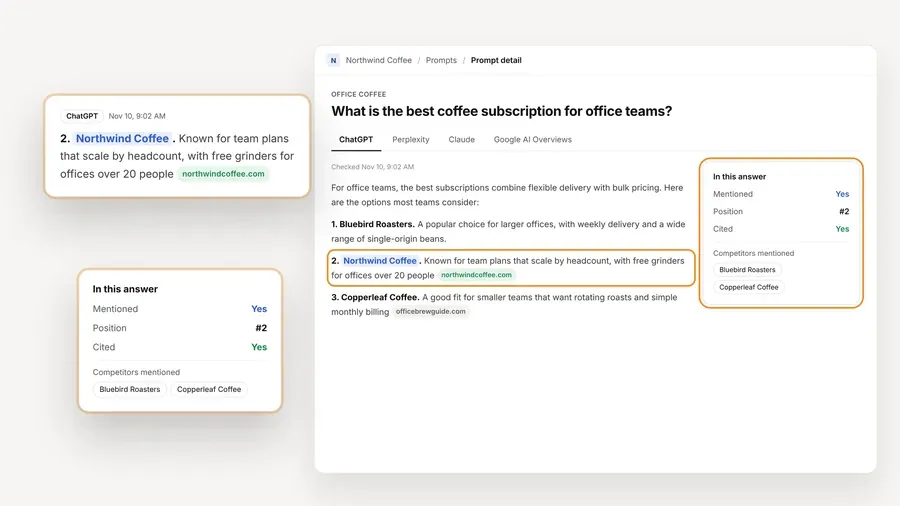
Each tracked prompt also keeps the raw AI answer for each engine, so you can open one and see whether the brand was mentioned, what position it held and whether it was cited. That matters when a client asks why a number moved, because you can show the actual answer instead of describing it. The numbers in that screenshot are demo data from a sample project.
For data costs and setup, you can choose scraped data, which is the answer a real user sees in the ChatGPT, Gemini or Google apps and is the cheapest, or API data, where you pick the exact model. If you track one client, you can start with scraped data on two or three engines and look at the cost preview before you run anything.

If you outgrow one project, Pro is $99 a month ($79 a month billed annually) for up to 10 client projects, and Unlimited is $499 a month ($399 a month billed annually). Every plan has every feature, and only the number of projects changes. The Free plan is for one brand, so if you run several clients you'll need Pro, and it's better to know that now than to find out in month three.
For moving over from another tool, the Done-For-You Switch imports prompts, competitors and tracking history from your current tool. We don't publish a Rankscale-specific import file, so treat it as a service you ask for, and read the migration section below for the one catch on Rankscale's cheapest plan.
Limitation to know about: one project on Free. That's the right size for one client or your own brand, and it's the reason Pro exists for a growing roster.
Best for: A team that wants a paid monitoring product with a wide engine list, usage priced in credits, and plans that scale from a small workspace to Enterprise.
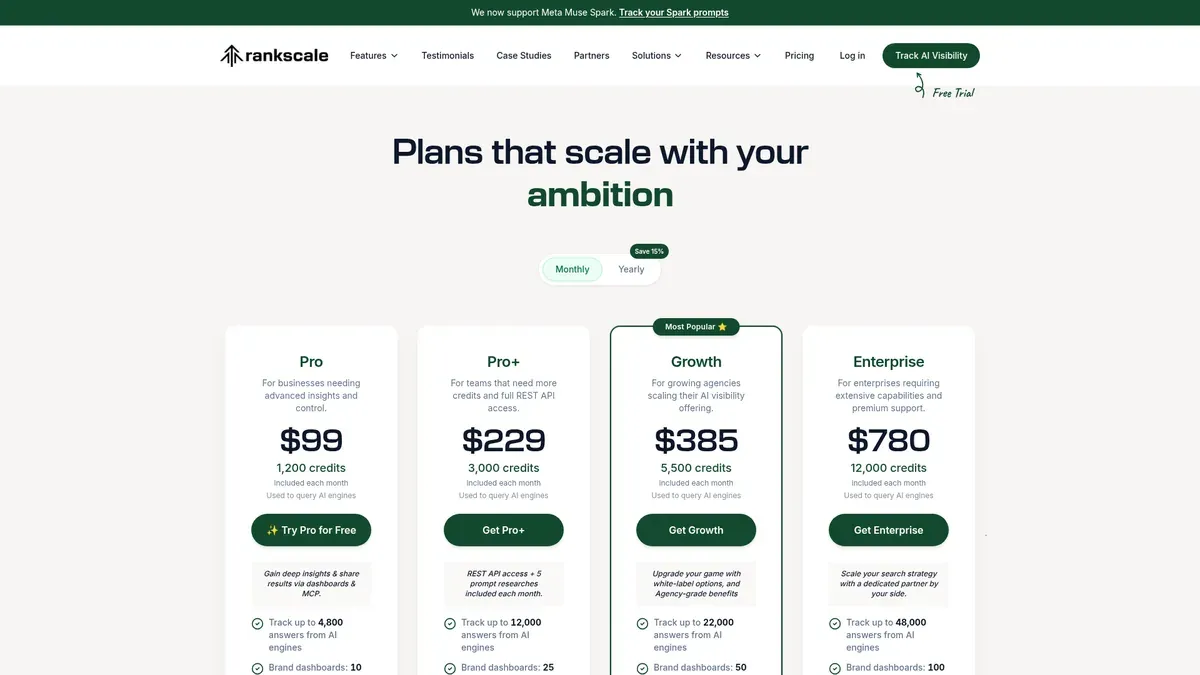
From its pricing page as of November 2026, Rankscale has five tiers. Essentials is listed at $20 a month, or $17 a month billed annually, with 120 monthly credits, up to 480 answers and 2 brands. Pro is $99 a month ($84 annually) with 1,200 credits and 10 brands. Pro+ is $229 ($195 annually), Growth is $385 ($327 annually), and Enterprise is $780 ($663 annually). All five list unlimited search terms, 17 or more engines, and scheduling from hourly to monthly. The homepage copy says plans start at $99 a month, which doesn't match the Essentials listing, so confirm the price at checkout before you rely on it.
Credits are how Rankscale meters usage. A typical engine query costs 0.25 credits per engine per prompt, though it varies by engine and by how the answer is collected. Failed runs don't use credits, and search terms you set to inactive don't run or use credits either.
On measurement, Rankscale is clear and worth learning from. Detection Rate is whether the answer included the brand, and the help page says it measures presence, not ranking quality. Mentions count how often the brand appears, and one answer counts as one mention even if the name appears several times in it. Average Position is where the brand tends to rank when it does appear. Citations are sources or URLs in the answer, and Share of Voice is the brand's portion of total mentions against competitors. It also gives a single Visibility Score that combines presence and position, using a formula its help article states.
Its free options are a trial and nothing permanent. The pricing page has a "Try Pro for Free" option, and the signup help says some plans include a trial with no charge until it ends. The length isn't stated in what we read. If you're on Essentials, note that it excludes sentiment, custom dashboards, CSV or Sheets export and the REST API.
Limitation for this reader: no permanent free plan, and a price that grows with credits. Choose Rankscale instead when you want its credit-based features and workflow and you're happy to pay for them.
Best for: Someone who wants to try a narrow free tracker and finds five prompts and 100 responses a month enough for a first check.
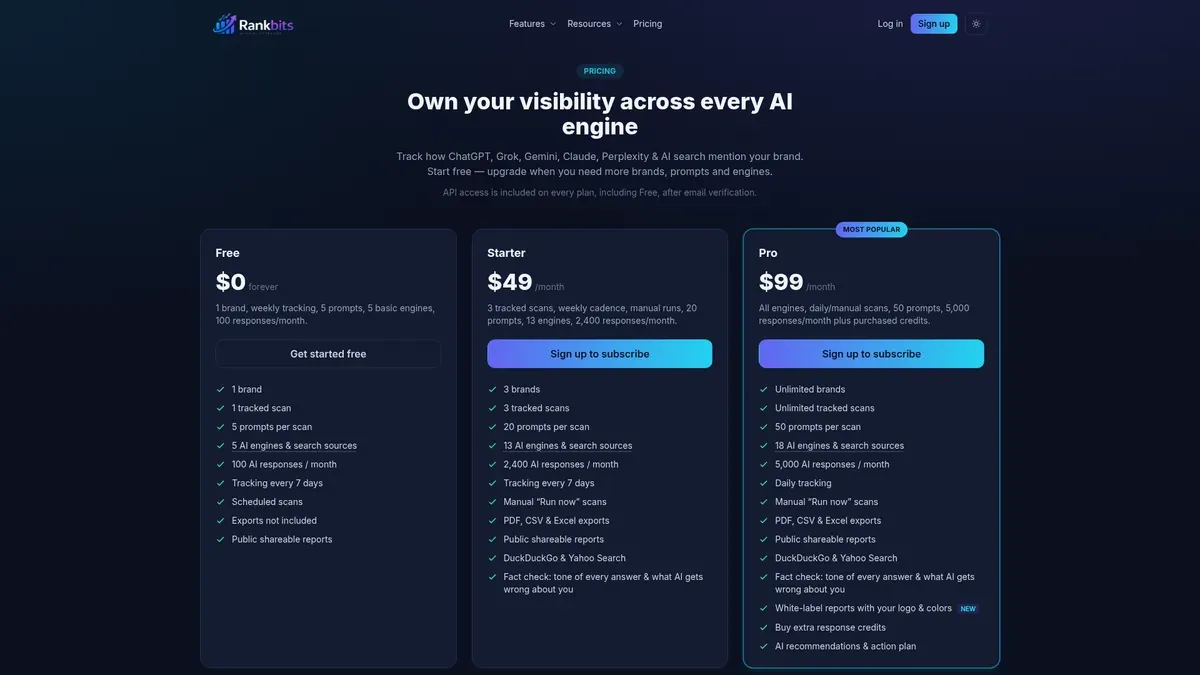
From its pricing page, the free plan is $0 forever for one brand, with one tracked scan, five prompts per scan and 100 AI responses a month across five engines or sources (ChatGPT, Google AI Overview, Google Search, Bing Search and Perplexity). Reports are public and shareable. Starter is $49 a month and Pro is $99 a month, and both add exports.
Limitation: the page says "weekly tracking" and also lists scheduled scans as not included, so how often the free plan really runs is unclear. Exports are not included on Free either. Check the sign-up flow before you build a client's tracking on it.
Best for: Someone who wants a small daily tracker and is willing to test whether its engine coverage fits the client.
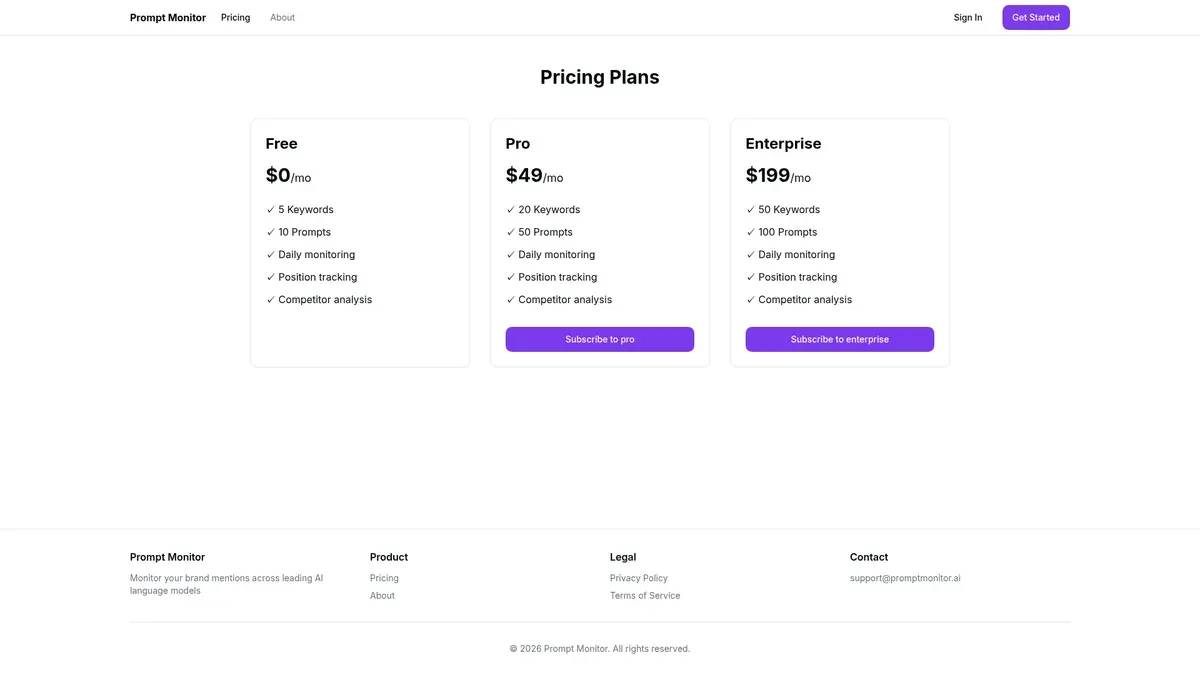
The pricing page lists a free plan at $0 a month with five keywords, ten prompts, daily monitoring, position tracking and competitor analysis. Pro is $49 a month and Enterprise is $199 a month.
Limitation: the pricing page doesn't say which AI engines it tracks, or anything about exports, data charges or importing prompts. Don't assume it covers ChatGPT, Gemini, Perplexity or Google AI Overviews until you've checked.
Best for: A one-time, no-sign-up look at a brand's AI mentions before you pick a tracker.
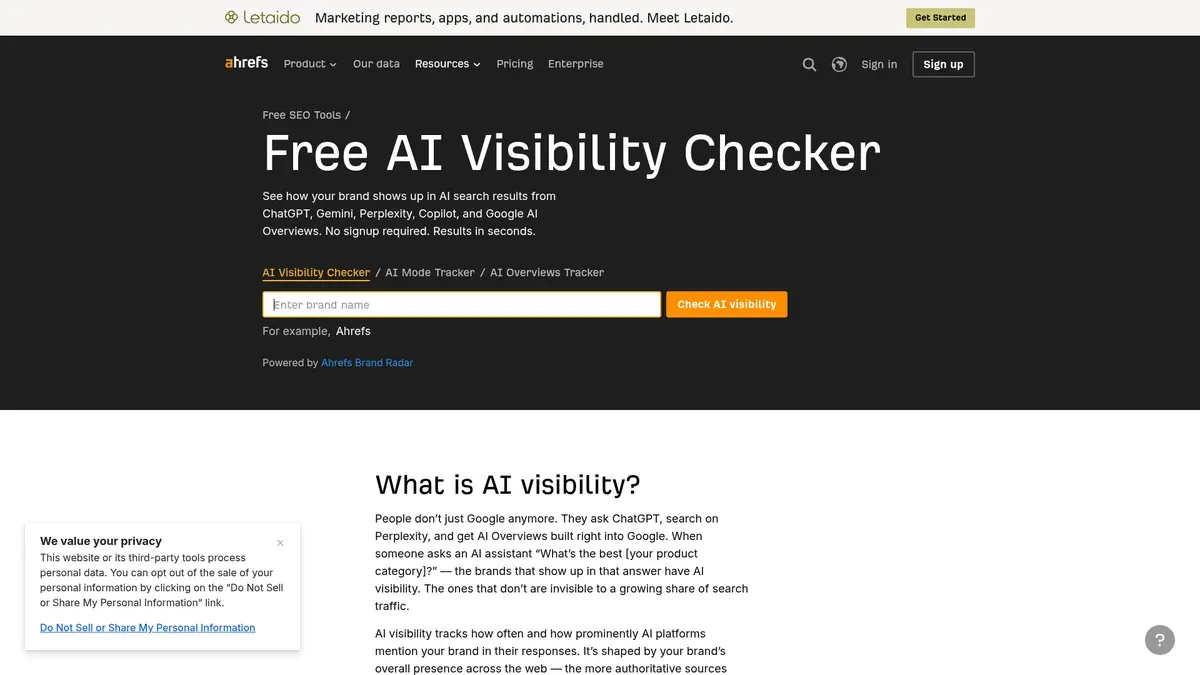
The checker looks at ChatGPT, Gemini, Perplexity, Microsoft Copilot, Google AI Overviews and Google AI Mode. The report shows total mentions, mentions by platform, the top five topics, and the top five cited domains and pages. Ahrefs separates a mention (the platform names the brand) from a citation (it links to the brand's site).
Limitation: it's a one-time snapshot with a limited preview, not ongoing tracking, and it doesn't document an average position. Competitor comparison, history and custom prompts sit in its paid product. It's good for a baseline, not as a replacement for your prompt list.
Best for: A quick, free read on how AI tools describe a business, with no account.

The Grader looks at how ChatGPT, Perplexity and Gemini characterize a business and gives a score out of 100 from five parts: sentiment (40 points), presence quality (20), brand recognition (20), AI Share of Voice (10) and market competition (10). The page says results are ready in under two minutes.
Limitation: it's a one-time check of brand perception. It has no tracked prompts over time and no way to bring a prompt list over.
Best for: A fast scan when you want a score, a competitor benchmark and a look at mentions and citations.

You enter a domain, and the scan runs buyer-style prompts across ChatGPT, Perplexity, Gemini and Google AI Overviews. The report is described as a 0 to 100 visibility score with rankings, a competitor benchmark, mentions, citations, cited pages and third-party sources. It's free to run without signup, and a free account unlocks the full breakdown.
Limitation: paid plans add ongoing monitoring and alerts, and the free page doesn't say anything about recurring runs or importing prompts.
When you move between trackers, the numbers rarely line up one to one, and that's normal. Each tool counts things its own way, so it helps to know where they differ before you tell a client.
Also remember that "position" here means where a brand appears inside an AI answer, or how it ranks among brands on a dashboard. It isn't a search results page position.
Here's a plain order of steps that works for most one-client setups.
If you want to try the free route, start free with AeoNut, connect one key, add your prompts and look at the cost preview before you run anything.
AeoNut is the clearest fit for ongoing tracking. Its Free plan is free forever for one project, with unlimited prompts and every feature, and you pay your own data provider for the AI answers.
Not permanently. The pricing page lists paid plans and a "Try Pro for Free" option, and the trial length isn't stated.
Rankscale documents CSV upload and export to CSV or Google Sheets, but its Essentials plan lists data exports as not included. AeoNut's Done-For-You Switch imports prompts, competitors and history from your current tool, so confirm your export route first.
No. The platform costs $0, but the provider whose key you connect charges for the answer data. A cost preview shows the estimate before a run, and budget caps and alerts keep it in check.
Tools & Comparisons ·
Compare free tools that report citation rate and brand mention rate as separate numbers, and see which are ongoing plans and which are one-time checkers.

Tools & Comparisons ·
Is a self-hosted AI visibility tracker worth your time? Compare setup, upkeep, data control and engine coverage with a managed free plan before you decide.

Tools & Comparisons ·
Which free AEO tracking tool keeps running, saves history and shows change? Compare five free options on schedule, trends and alerts to pick one for a client.