Tools & Comparisons ·
Free Tools That Track Citations and Brand Mentions Separately
Compare free tools that report citation rate and brand mention rate as separate numbers, and see which are ongoing plans and which are one-time checkers.
Looking for a free searchable alternative? Compare AeoNut Free with Ahrefs, Track My Visibility and HubSpot, and see where Searchable's paid tiers differ.
Avinash Saurabh · · 17 min read
If you track AI visibility for a client and you're looking at Searchable's pricing, it's normal to wonder whether a free searchable alternative exists, one that keeps running after a trial ends and doesn't cap the questions you can ask. There is one. AeoNut's Free plan tracks one client brand with no platform fee, no card and no end date, with unlimited prompts across all twelve engines AeoNut supports. The one thing to keep straight from the start is that the platform is free and the AI answer data is not. You connect your own provider keys, and the providers bill you for the answers they return, at their own prices.
This guide compares that setup with the other free options a consultant is likely to find, and then with Searchable's paid tiers, so you can see what staying free holds up against and where it stops. It was written for a freelance SEO or AEO consultant with a handful of clients, the setup covered in our guide to free AI visibility tracking by reader and industry, so the ranking leans toward that job: watching one client over time and handing over a report with your name on it.
A lot of "free" AI visibility offers turn out to be one of three different things: a free platform, a free report, or a free trial, a split our guide to a free plan, free trial or one-off checker lays out in more detail. They solve different problems, so we sorted the options by five questions that matter for ongoing client work.
These questions favor a consultant who tracks one client over time. They are not a ranking of everything each product can do, and a tool that scores low here may still be the right pick for a different job. We say where that is true in each entry.
| Rank | Free offer | Prompts on the free offer | Engines on the free offer | Reporting and continuity | When needs grow |
|---|---|---|---|---|---|
| 1. AeoNut | Free-forever platform, one client project, data billed by your providers | Unlimited | Twelve engines, including all five above | Ongoing tracking, trends, white-label reports, CSV, MCP server and API | Pro covers up to 10 client projects |
| 2. Ahrefs AI Visibility Checker | Free, no signup or card | Search-backed prompts, no published custom-prompt allowance | ChatGPT, Gemini, Perplexity, Copilot, Google AI Overviews, Google AI Mode | One-time snapshot with top-five previews | Brand Radar is the paid monitoring product |
| 3. Track My Visibility checker | Free report, no card, emailed after contact verification | Niche questions chosen by the tool | ChatGPT and Perplexity | One-time snapshot of score, rank and competitors | Paid plans add daily tracking and your own prompts |
| 4. HubSpot AI Search Grader | Free one-time diagnostic, a form unlocks the full report | Brand-perception assessment, no custom prompts published | ChatGPT, Perplexity and Gemini | Composite score and written interpretation | HubSpot AEO is a separate paid product |
Searchable is not in the ranking because this is a searchable ai visibility alternative guide, and Searchable is the tool you're replacing. Its free offer is a one-time report, and its ongoing plans are paid, so we cover it as a benchmark after the four options.
Best for: a freelance consultant who wants to track one client properly, show a trend at the next reporting meeting, and send reports under their own name before any monthly platform fee comes into the picture.
AeoNut's Free plan is built around three things: free forever, unlimited prompts and your own keys. It isn't a trial, and if you want to test any free forever claim yourself, our guide to free forever claims in AI visibility tools shows how. There's no clock running while you work out whether the data is useful. Every feature is included on every plan, and the plans differ only in how many client projects they hold. Free holds one project, Pro holds up to 10, and Unlimited has no cap.
That matters for a Searchable comparison because of where each tool puts its limits. On Searchable's pricing page, as of November 2026, the brand Pro plan lists 100 tracked prompts per model, and white-label reports are not included until the Scale tier. On AeoNut Free the prompt count is not a limit at all, and a comparison of free AI visibility plan limits lines up the limits across free plans, and white-label client reports, CSV export, the MCP server and the API are all part of the free plan. When you add prompts, add reporting needs or want a team member to look at the data, nothing about that pushes you to a higher AeoNut plan. The upgrade trigger is a second separate client project.
Each project is one client brand with its own prompts, competitors, settings and reports. You choose the engines, the countries, the prompts and how often it runs: daily, twice a week or weekly. The twelve engines are ChatGPT, Gemini, Perplexity, Claude, Grok, Google AI Overviews, Google AI Mode, Mistral, Meta AI, Qwen, Z.ai and MiniMax, so the five most clients ask about are covered without a plan change. For each engine you can pick scraped data, which is the answer a real person sees in the app, or API data from the exact model you choose. Those are two different routes, so keep one route per client if you want clean trends.
What you read back is Mention rate, Cited, Avg. position, Share of voice and Sentiment, with trends by engine, prompt and country. You can see a competitor leaderboard, the pages and domains the engines cite, and the raw answer for each prompt, so when a number moves you can open the answer and see why. Client reports and shareable links carry your branding, not AeoNut's, and export as PDF, Excel or Markdown.
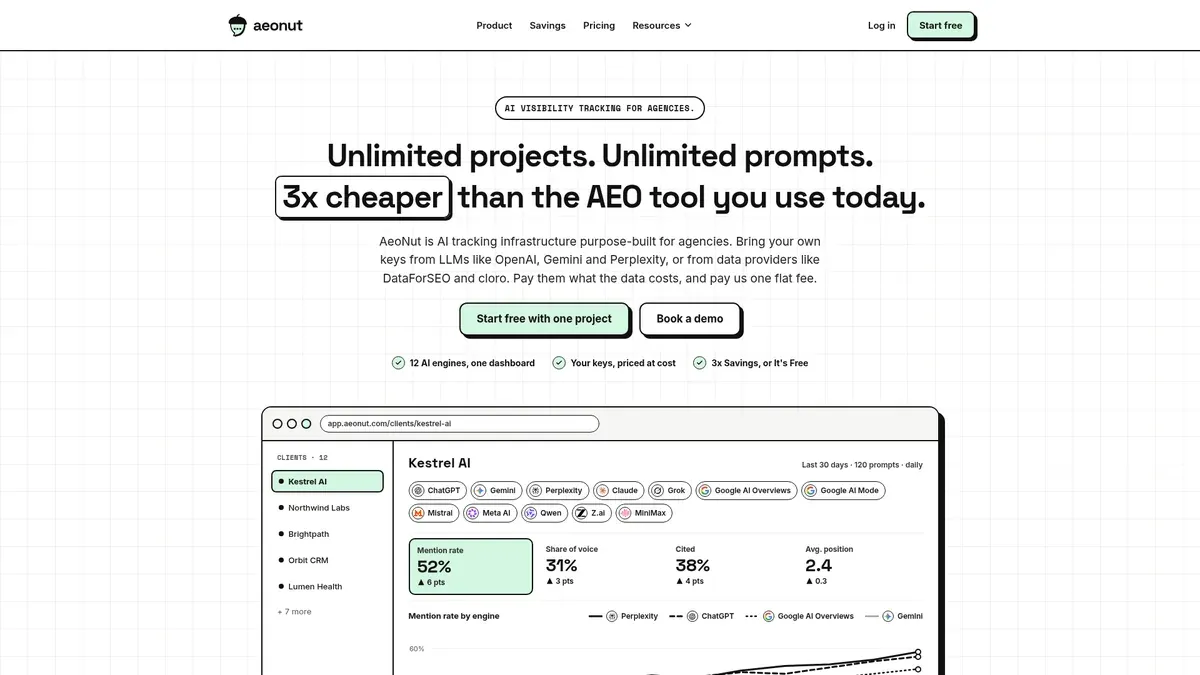
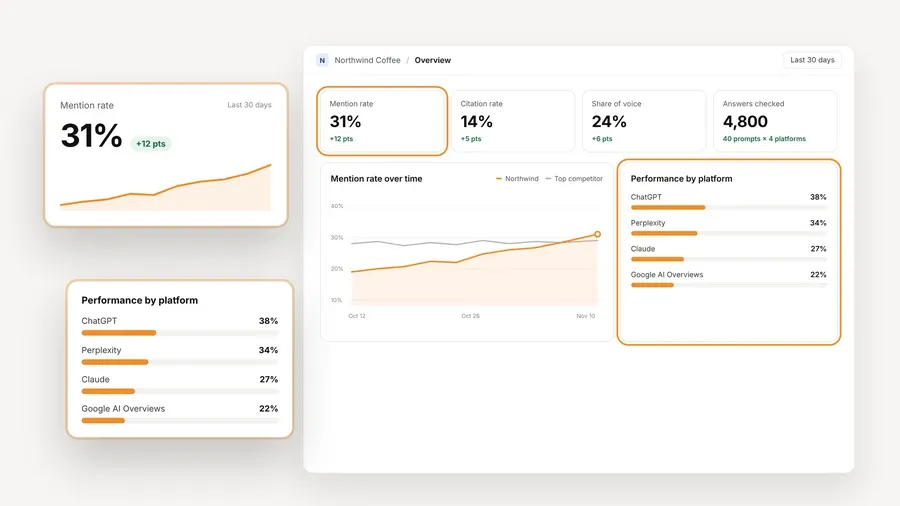
The screenshot above is from a demo workspace, so the numbers are sample data and not a client result. What it shows is the shape of what you'd bring to a client call: one project, a trend line against the top competitor, and a split by engine.
You connect keys from OpenAI, Anthropic, Gemini, Perplexity or DataForSEO and pay those providers directly, at their prices. AeoNut doesn't mark the data up. One key from one provider is enough to start. Before tracking runs, a cost preview shows the estimated monthly spend, and you can set budget caps and alerts. AeoNut also recommends restricted keys with spending limits and shows you how to set them up, which keeps a runaway bill from catching you off guard.
For a sense of scale, AeoNut's published example is ten clients with 100 prompts each, tracked daily on ChatGPT, Perplexity and Google AI Overview, at about $135 a month in data. Add the $99 Pro fee and that's about $234 a month. That's a ten-client example, so it isn't what one client costs, and it isn't a quote for twelve engines. Adding Gemini and AI Mode would change the provider estimate, which is why the cost preview is worth checking before you start.

Free covers one client project, and collecting answers still costs whatever your provider charges. For a consultant starting with one client, that fits, and the cost preview, caps and provider-side limits keep the spend in view. When a second client needs its own ongoing project, Pro covers up to 10 projects on one flat fee of $99 a month, or $950 a year, with the data still billed by your providers. If you're switching from another tool, a free setup call and the Done-For-You Switch can import prompts, competitors and history.
Best for: a quick prospect conversation where you want to see several AI surfaces at once without creating an account or connecting a key.
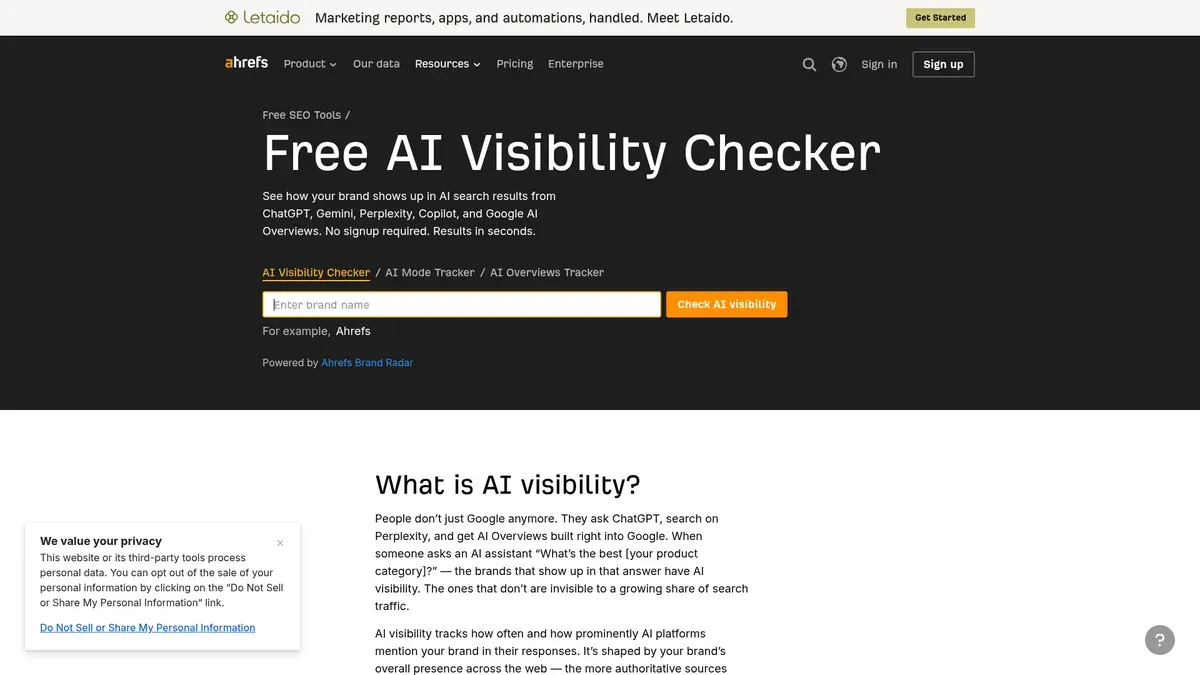
The free checker from Ahrefs covers six named surfaces: ChatGPT, Gemini, Perplexity, Copilot, Google AI Overviews and Google AI Mode. There's no signup, no card, and the page doesn't publish a limit on how many brands you can check. That's a wider spread than most free tools offer, and Google AI Mode is included, which a lot of others leave out.
The report shows total AI mentions, mentions by platform, and the top five topics, cited domains and cited pages. Ahrefs says the questions are search-backed prompts drawn from real Google search behavior. That tells you where the prompts come from, but it doesn't mean you can swap in your client's own prompt set on the free checker.
It's a one-time snapshot, and that's the limit that matters. Trends, ongoing monitoring, share of voice and custom prompts belong to Brand Radar, the paid product, which Ahrefs advertises at $199 a month for a selected-platform offer and $699 a month for all platforms. A top-five preview is a good opener for a first meeting and a thin base for a monthly client report. Pick Ahrefs when speed and no account creation matter most. Pick AeoNut when the next thing you need is the same client, tracked again next month, and read per-engine free checkers or one free tracker if you're weighing several single-engine tools.
Best for: a prospect report you can send quickly, when ChatGPT and Perplexity are the engines that matter.

You enter a website and the report arrives by email in about two minutes, which is the vendor's own estimate and not a measured guarantee. It's free with no card, though it does verify your contact details first, so "no card" doesn't mean "no information." The report includes an AI Visibility Score, an overall rank, the top queries where the brand ranks, missed opportunities and a competitor leaderboard, across ChatGPT and Perplexity.
The tool picks the questions for you, in the brand's niche, and the page we reviewed doesn't say how many. Your own prompts are a paid feature, with paid plans advertised from 50 to 300 prompts a day. The free offer is described as a one-time snapshot, and the FAQ places citation tracking in the paid plans.
A note on the paid side. Its public pricing page shows conflicting figures for the entry plan, with a monthly price on the card that differs from the one in the table and FAQ, so we won't quote a single number for it. A separate 7-day trial costs $5, which makes it a paid trial and not a free plan. Use the free checker for an emailed ChatGPT and Perplexity diagnostic. Use AeoNut when you need your own prompts, all five engines and a branded report that builds a trend.
Best for: a first conversation about how AI describes a brand, as opposed to how a set of buyer questions performs over time.

HubSpot describes its grader as a free, one-time check based on the models' training data, so it is not live-search monitoring. It names ChatGPT, Perplexity and Gemini, and the OpenAI portion uses GPT-5.4 mini, which means it shouldn't be read as an exact copy of what people see in the consumer ChatGPT app. You enter a company name, location, industry and product, and the report scores five dimensions out of 100 points: Sentiment Results (up to 40), Presence Quality (20), Brand Recognition (20), Share of Voice (10) and Market Competition (10), with a written interpretation.
The page says no account is required, but a form unlocks the full report, so both statements are true. That sentiment-heavy score is useful if the first question is how a brand comes across. It isn't a mention rate on a stable prompt list, so a 70 here can't be compared with a 70 from another tool.
HubSpot also sells a paid product, HubSpot AEO, at $50 a month, or $45 a month billed yearly, with a trial covering 25 prompts across ChatGPT, Perplexity and Gemini. That's a legitimate lower-priced paid option if three engines and 25 prompts are enough and the HubSpot connections matter to you. It isn't the same service as the free grader, and it's a trial and not a permanent free tier.
Searchable belongs here as a baseline. Everything below comes from its own pricing and free-report pages as of November 2026, and prices are in USD.
The correction worth making about the searchable free tier vs paid question is that its public pricing doesn't list a permanent free tier for ongoing tracking. What it offers for free is a visibility report: no card required, delivered in minutes, covering ChatGPT, Google and Perplexity, with a score, competitor comparisons, share-of-voice gaps and sentiment. The report page doesn't say which Google surface "Google" means, how many prompts it uses, or whether you can run it repeatedly, so it reads as a diagnostic and not a recurring plan. Searchable also lists 14-day free trials on its brand Pro and Scale plans and its agency Launch and Growth plans.
The paid plans are where the comparison gets concrete.
| Plan | Base price per month | Annual commitment | Tracked prompts per model | Projects | White-label reports |
|---|---|---|---|---|---|
| Brand Pro | $125 | $1,200 a year | 100 | 1 | Not included |
| Brand Scale | $400 | $3,840 a year | 500 | 10 | Included |
| Agency Launch | $250 | $2,400 a year | 200, plus 200 pitch prompts | 5 | Included |
| Agency Growth | $400 | $3,840 a year | 500, plus 500 pitch prompts | 10 | Included |
Two things in that table are easy to get wrong. First, you don't need a $400 plan to get white-label reports as a consultant, because agency Launch includes them at $250 a month, with Looker Studio, MCP and API access too. Second, the prompt numbers are per model, and the pricing pages don't make clear whether they are shared across projects or repeated for each one, so don't multiply them by your client count. Pitch prompts are a separate allowance for temporary prospect projects, and they shouldn't be added to the tracked prompts.
On engines, every standard plan includes ChatGPT, Google AI Overviews and Perplexity. Gemini and Google AI Mode are paid add-ons, along with Claude, Grok, Copilot, DeepSeek and Meta Muse, and the annual discount doesn't apply to those add-ons. We couldn't confirm the add-on prices, so we're not putting a number on them. What we can say is that Searchable's base price covers three of the five engines in our criteria, while AeoNut's platform covers all five on Free, with the cost shifting to your providers.
Searchable also bundles site audits and articles. The Pro and Launch tier lists 200 audits and 20 articles a month, and higher tiers list more. If you'd use those, a paid Searchable plan is a reasonable purchase, and AeoNut is a tracking replacement and not a swap for that whole bundle. Searchable's own docs describe PDF reports, CSV exports and daily, weekly or monthly scheduling, so its reporting is not weak. The honest difference is the commercial shape: a monthly platform fee with plan-based prompt and engine limits, against a free platform with your data billed by your providers.
A caution on comparing totals. We haven't verified a like-for-like savings figure against Searchable, and a fair one would need the same prompts, projects, engines, frequency and data route on both sides. If you price it yourself, use AeoNut's cost preview for the data side and Searchable's pricing page for its side, and write the assumptions down.
Start with the job, because each option above does a different one.
Keep the platform free with AeoNut when one client brand needs recurring tracking and not a prospect snapshot, when your prompt list is still growing and a small allowance would make you cut questions, when Gemini and Google AI Mode matter next to ChatGPT, Perplexity and AI Overviews, and when reports need your branding. You should be comfortable with provider keys and want to see a data estimate before anything runs. The point where this changes is your second ongoing client project, not a larger prompt list or a second report.
Use a free diagnostic instead when the task is smaller. Ahrefs fits a broad first look with no account, including AI Mode. Track My Visibility fits an emailed ChatGPT and Perplexity report for a prospect. HubSpot's grader fits a conversation about brand perception and sentiment. None of the three becomes a trend tracker by being run again, which is the usual way a free checker disappoints a consultant who needed monthly numbers.
Pick paid Searchable when you'd use its audit and content bundle, its separate pitch allowance or its native Looker Studio reporting, or when you're satisfied with the three included engines and the prompt allowance and would rather have one packaged subscription than manage provider keys. Consider paid HubSpot AEO when 25 prompts on three engines is enough for the client.
If you want a wider view of the choices, our guide to free alternatives to paid AI visibility trackers covers what you keep and give up when you leave a paid tool, and another guide on which kind of free offer fits you sorts free offers into plans, trials and checkers. Free AI visibility tools by job maps tracking tasks to tools, and free AEO, GEO and LLM tracking tools explains why vendors use different labels for the same work. For what survives over time, see free AI search monitoring tools that keep your tracking history.
If you want to see whether a free searchable alternative holds up for your own client, set up one project on AeoNut Free. Pick a real starting set of prompts, the questions the client's buyers ask before they buy, connect one provider key and look at the cost preview before you start tracking. You'll get tracking with no platform subscription for that project, unlimited prompts, and provider data billed separately by the provider. Start free with AeoNut with no card and no sales call.
Yes. AeoNut's Free plan tracks one client brand with unlimited prompts, analytics and white-label reports, and you bring your own provider keys and pay the providers for the answer data. The other free options we reviewed, from Ahrefs, Track My Visibility and HubSpot, are one-time checkers or graders and not ongoing tracking plans.
As of November 2026, its public pricing doesn't list a permanent free tier for ongoing tracking. It offers a free visibility report and 14-day trials on its brand Pro and Scale plans and its agency Launch and Growth plans. Enterprise buyers are directed to the team, so don't assume they get the same trial.
The platform fee is $0 for one project. Your chosen provider bills you for collecting answers, at its own prices, and the amount depends on your prompts, engines, how often tracking runs and whether you use scraped or API data. AeoNut shows a cost preview before tracking starts, and you can set budget caps and alerts, plus spending limits on the keys themselves.
On AeoNut, more prompts and more reporting don't require an upgrade, because those are already part of Free. A second separate client project does, and Pro covers up to 10 projects for $99 a month. Provider spend can still rise as you track more, and a one-time checker stays useful for prospecting but won't turn into a trend tracker just because you run it again.
Tools & Comparisons ·
Compare free tools that report citation rate and brand mention rate as separate numbers, and see which are ongoing plans and which are one-time checkers.

Tools & Comparisons ·
Is a self-hosted AI visibility tracker worth your time? Compare setup, upkeep, data control and engine coverage with a managed free plan before you decide.

Tools & Comparisons ·
Which free AEO tracking tool keeps running, saves history and shows change? Compare five free options on schedule, trends and alerts to pick one for a client.