
Tools & Comparisons ·
Free Tools That Track Citations and Brand Mentions Separately
Compare free tools that report citation rate and brand mention rate as separate numbers, and see which are ongoing plans and which are one-time checkers.
Looking for a free Scrunch alternative? Compare free-forever and trial options on price, prompts and engines, then start tracking your brand in AI answers.
Avinash Saurabh · · 14 min read
If a client has asked whether they show up in ChatGPT and you are looking at Scrunch to answer them, the first thing to know is that Scrunch is a paid product with a short trial, and Core costs $250 a month after that. That is a lot to commit to before a client has agreed to pay for tracking. This guide is about finding a free Scrunch alternative that keeps running after a week, so you can show a client real AI answer data and a trend, and decide on a paid tool later with numbers in hand.
One correction before the list. A lot of people search for a "scrunch alternative no sales call" because they assume Scrunch makes you book one. For Core, it doesn't. Scrunch's pricing page offers a self-serve "Get started" route, and its FAQ says you can sign up without talking to sales. The sales demo is for Enterprise. So the real difference between Scrunch and a free tool is the price and the clock on the trial, not a call, and that is how this list is built.
We compared tools that run recurring tracking on a schedule, not one-off checkers that give you a single score. Four things decided the order.
Prices below are from each tool's public pages as of November 2026. Allowances are counted in different units across these tools (prompts, prompt-model calls, responses), so the table keeps each unit as the vendor states it.
| Tool | Free offer | Engines on the free offer | Paid entry point | Best for |
|---|---|---|---|---|
| AeoNut | Free forever, 1 project, unlimited prompts, no card (you pay your own data provider) | All twelve tracked engines | Pro, $99 a month or $79 billed annually, up to 10 projects | One brand, ongoing, broad coverage |
| FoxRadar | Free, 15 AI calls a month, no card | ChatGPT | Fox Starter, €29 a month | A tiny ChatGPT check |
| Rank Tracking | Free, 1 project, 3 prompts weekly, no card | ChatGPT | Go, $19 a month | Validating a few ChatGPT prompts |
| Scrunch Core | No permanent free plan, 7-day trial | Four on Core: ChatGPT, Perplexity, Google AI Overviews, Copilot | Core, $250 a month | A paid monitoring baseline |
Moving from a paid platform to a free tracker is mostly a question of scope. On a free tracker you keep the part that matters most for a first client conversation, which is real AI answers for real buyer prompts, checked on a schedule, so you can show whether the brand appears and whether it is cited. What changes is how much a tool lets you run for free. AeoNut Free keeps unlimited prompts and every feature but holds one project. FoxRadar and Rank Tracking keep the idea of a free ongoing tier but cap it at a handful of ChatGPT checks.
Scrunch Core sits on the other side of that trade. You get four engines, 125 unique prompts and 5,000 responses a month, one brand workspace and a reporting dashboard with citations and prompt management, and you pay $250 a month for it. If you already know the client will pay for tracking, that can be a sensible purchase. If you don't know yet, a free tool lets you answer the "are we showing up?" question first and spend later.

Best for: a freelance SEO or AEO consultant who wants to track one client brand properly, on more than one AI engine, without a monthly platform bill.
AeoNut is the only AI visibility tracker that is free forever with unlimited prompts. Some tools have credit-capped free plans, and several offer free one-off checkers or graders, but those are not ongoing tracking with no prompt limit. On AeoNut Free you get one client project, unlimited prompts, every feature and no card. You bring your own provider key, so the platform costs nothing and the AI answer data is what your provider charges.
That last part is worth saying plainly. The platform fee is $0, and the data is not free. When you connect a key from OpenAI, Anthropic, Gemini, Perplexity or DataForSEO, that provider bills you directly at its own price, and AeoNut never marks it up. You can see what a run will cost before it starts, because the cost preview shows an estimate first, and you can set budget caps and alerts per client. It also helps to create a restricted key with a spending limit, which AeoNut shows you how to do, so a mistake in the prompt list can't turn into a surprise bill. For a sense of scale, AeoNut's own example is about $135 a month in data for 10 clients with 100 prompts each, tracked daily on ChatGPT, Perplexity and Google AI Overview. One client with a smaller prompt set costs a fraction of that, and you can check the exact figure in the preview.
Here is what you get inside that one project.
The first figure below is the part a client will ask about on a call. It shows one project's Mention rate, Citation rate and Share of voice over time against a top competitor, with the answers checked and a breakdown by platform. The numbers in these screenshots are demo data, not results from a real client.

The second figure is the part that keeps the bill honest. Each AI platform is connected once with your own key, every project can use it, and each key shows whether it is working.

Limitation: Free covers one client project, and the provider charges for data. If you already track several clients, you will want Pro (up to 10 projects) or Unlimited, and if you expected data to cost nothing, the cost preview and spending limits are what keep that expense small and predictable. For a consultant with one client or one brand of their own, the single project is rarely the thing that gets in the way.
Best for: a consultant who wants the easiest possible start on a few ChatGPT prompts and doesn't mind a strict monthly cap.
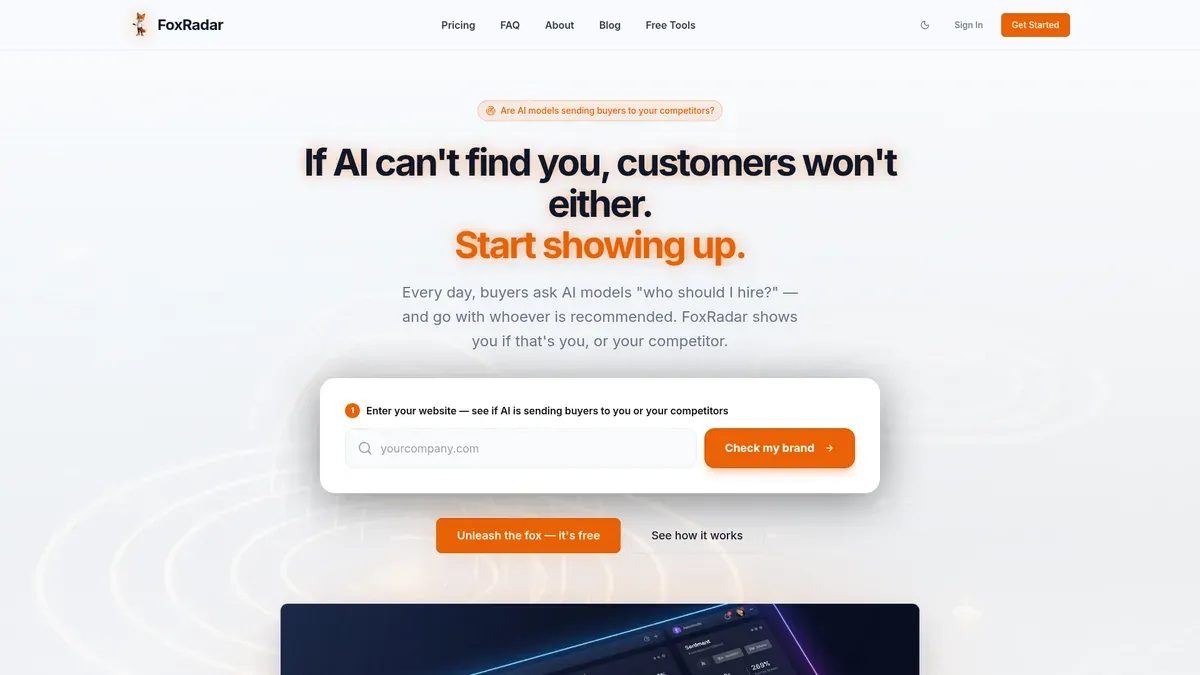
FoxRadar checks whether a brand is mentioned in AI answers and shows competitors that appear instead. Its free tier is ongoing, with no card, and it gives you 15 AI calls a month on ChatGPT. A call is one prompt on one AI model, so each time a prompt runs on ChatGPT it uses one call. The pricing page lists unlimited projects and questions, but the 15 calls are the real ceiling. Tracking a single prompt daily on one model would use about 30 calls in a 30-day month, which is twice the free allowance, so on Free you are choosing a handful of prompts and a lower frequency.
Features worth knowing about are daily tracking updates, historical position tracking, an AI Advisor that suggests actions, and email reports that can be daily, weekly or monthly, all listed as free. Paid plans are Fox Starter at €29 a month (150 calls, ChatGPT, Gemini and Grok), Fox Growth at €79 a month (500 calls) and Fox Agency at €199 a month (1,500 calls). Extra calls are billed automatically, and the rate isn't stated on the pages we reviewed. The reviewed pages also don't specify integrations, API access or export formats, so check those before you promise a client a particular report.
Limitation: The free tier is ChatGPT only and capped at 15 calls a month. That suits a very light recurring check, and it is thin for a client report that needs several engines and a steady prompt set.

Best for: a consultant who wants to see whether prompt tracking is useful for a client before spending anything, and who is fine starting with ChatGPT alone.
Rank Tracking monitors AI visibility, mentions, cited sources and competitor presence. The free plan is $0, with one project, three prompts a week and ChatGPT tracking, and no card. Source tracking shows which pages AI systems cite, and the tool reports how positions move across repeated runs and where competitors overlap across prompts.
Paid plans widen the limits. Go is $19 a month for 3 projects and 5 prompts every 5 days, with ChatGPT and Google AI results. Plus is $119 a month for unlimited projects and 50 prompts every 5 days, with ChatGPT, Gemini, Grok, Perplexity and Google, and advanced reporting. The reviewed pages don't specify export formats or third-party integrations, so ask before you build a client report around them.
Limitation: Three prompts a week on ChatGPT is a small test allowance, smaller than a single topic cluster of buyer questions. It is a fair way to try the idea, and you will likely outgrow it once a client wants real coverage.

Best for: a team that wants Scrunch's monitoring workflow, has the budget for a subscription, and is happy to judge it during a short trial.
Scrunch covers brand presence, competitor presence, position, sentiment and citations, and its monitoring guide describes daily snapshots for each model. Scrunch supports nine platforms overall, and which ones you can turn on depends on your plan. Core is $250 a month and includes 125 unique prompts, 5,000 responses a month, one brand workspace and five user licenses. Core runs four LLMs: ChatGPT, Perplexity, Google AI Overviews and Copilot. It also lists one country, one persona, one language and five competitors, and it leaves out Looker Studio, Query API, MCP and CLI access. The reviewed pricing page doesn't say which export formats Core has.
There is a seven-day Core trial, and signup is self-serve. Scrunch's own pages disagree on payment, though. The pricing page says no credit card is required, while a trial FAQ says a card is needed and that you upgrade to a paid plan automatically unless you cancel. Check the signup screen yourself before you count on a card-free trial, and set a reminder to cancel if you are only testing. Per its billing help, cancelling keeps access until the end of the billing cycle and then the account goes inactive.
Limitation: Core is not free after the trial, it is $250 a month, and the prompt, response, brand and engine limits are fixed. If you are looking for a scrunch ai free alternative that keeps running, this is the benchmark rather than the answer. That said, if your client already wants Scrunch and is paying for it, Core is a reasonable choice and you don't need to book a call to start.
A few terms come up in every tool on this list, and it helps to know what each one tells a client.
When you report these to a client, keep the prompt set and the schedule the same from one month to the next. The numbers can then be compared, and a change means something about the brand rather than about how you asked the question.
You can get the first tracker running in a single sitting, and a few early choices decide how useful it will be.
Start by watching Mention rate and Cited separately. A mention means the engine named the brand, and a citation means it linked to the brand's site as a source, and an answer can have one without the other.
Match the tool to the situation you are in.
If you want to see your own brand in AI answers this week, start free with AeoNut and connect one key.
Yes. AeoNut has a free forever plan for one project with unlimited prompts and no card. You supply a provider key and pay that provider for data. FoxRadar and Rank Tracking also list free ongoing plans, but with smaller call or prompt allowances.
No. Scrunch says Core has self-serve signup, and its trial FAQ says you can sign up without speaking to sales. The trial lasts seven days and Core is $250 a month. Its own pages conflict on whether the trial needs a credit card, so check the signup screen.
The platform is $0. The provider charges for the AI answer data generated with your key. AeoNut shows a cost preview before a run and recommends restricted keys with spending limits.
AeoNut is the closest fit if you want unlimited prompts, a choice of engines and an ongoing one-project setup, and you are comfortable paying a data provider. Rank Tracking or FoxRadar can work if you only need a small number of ChatGPT checks.
Tools & Comparisons ·
Compare free tools that report citation rate and brand mention rate as separate numbers, and see which are ongoing plans and which are one-time checkers.

Tools & Comparisons ·
Is a self-hosted AI visibility tracker worth your time? Compare setup, upkeep, data control and engine coverage with a managed free plan before you decide.

Tools & Comparisons ·
Which free AEO tracking tool keeps running, saves history and shows change? Compare five free options on schedule, trends and alerts to pick one for a client.