
Tools & Comparisons ·
Free Tools That Track Citations and Brand Mentions Separately
Compare free tools that report citation rate and brand mention rate as separate numbers, and see which are ongoing plans and which are one-time checkers.
Looking for a free Similarweb AI visibility alternative? See what AeoNut, GEOflux, LLMrefs and OtterlyAI offer, and which metrics you can track yourself.
Avinash Saurabh · · 17 min read
If a client asked you whether they show up in ChatGPT and you opened Similarweb to answer, you probably noticed the price. A free Similarweb AI visibility alternative is worth looking for when you track one or two brands and the dedicated package costs $129 a month, or $99 a month billed annually, for 150 tracked prompts and one user. Plenty of freelancers and consultants are in that spot. You want a real trend for a client, and you don't want to carry a subscription before the client has paid for anything.
The short answer is yes, there are free options. This guide compares the ones that hold up, explains what a free tracker can and can't reproduce from Similarweb's data, and helps you decide whether to keep the bigger platform. It covers only the AI brand visibility part. Similarweb's traffic estimates and market intelligence are separate products, and no tracker in this article replaces them.
You are choosing for a specific job: ongoing tracking of one brand's presence in AI answers, handed to a client in a form they can read. So the criteria come from that job.
AeoNut is first because it is the one built around that exact job, and the reasons are laid out in its entry. Every other tool gets the same fair read, including where it is the better pick.
| Tool | Ongoing free option and price | Prompt and capacity picture | Tracking and reporting fit | Main caveat |
|---|---|---|---|---|
| AeoNut | Free forever, $0 platform fee, one client project | Unlimited prompts, every feature included | Twelve engines, project-level scope and schedule, white-label client reports, CSV export, API and MCP server | You bring a supported provider key, and the provider charges for the data |
| Similarweb AI Brand Visibility | No perpetual free plan verified. Listed at $129 a month, or $99 a month billed annually | 150 tracked prompts, one user, three months of history | Real-user prompt data, daily responses, sentiment and citation analysis | The package says "Try for free", but trial terms for this package are not confirmed |
| GEOflux | Free forever, no card, limited to 500 accounts | 45 credits, described as 15 prompts, three competitors, refresh every three days | Reports, CSV export, email digests, competitor gap analysis | Tight caps, and its own pages disagree on which engines Free includes |
| LLMrefs | $79 a month, with a seven-day trial | 500 tracked prompts, unlimited projects and team members | Weekly reports, citations, share of voice, position, CSV and API | Not a documented permanent free plan |
| OtterlyAI | Paid plans from €29 a month, seven-day trial with no card | 16 prompts on Lite, 120 on Standard, 403 on Premium | Several engines, exports and reports, API and MCP on higher plans | Credit-limited plans, prices shown in euros |

Best for: A solo consultant who needs to start tracking a client or a pitch prospect today, wants a trend and not a one-off answer, and is comfortable connecting a provider key.
The first thing to know is what "free" covers. AeoNut's Free plan is free forever, with no card, for one client project, unlimited prompts and every feature. It is the only AI visibility tracker that is free forever with unlimited prompts, which matters because other tools either cap their free plans with credits or only offer a one-time checker. The platform costs nothing. The AI answer data is billed by your own provider at its price, and AeoNut shows a cost preview before anything runs, so the number is never a surprise.
Here is how it works in practice. You set up the client's brand, add the prompts their buyers ask, add the competitors, and pick the engines, countries and schedule. AeoNut then runs those prompts and records whether the brand is mentioned and cited, where it shows up in the answer, and which sources the engines cite. It covers twelve engines: ChatGPT, Gemini, Perplexity, Claude, Grok, Google AI Overviews, Google AI Mode, Mistral, Meta AI, Qwen, Z.ai and MiniMax. That is a wider list than the four engines Similarweb's visibility tracker names.
The metrics line up well with what Similarweb reports. You get Mention rate, Cited, Avg. position, Share of voice against tracked competitors and Sentiment, with trends by engine, prompt and country. You can also open the raw answer for any prompt, see which pages of the client's got cited, see which competitor pages got cited, and see each source domain tagged as the client's, a competitor's or neither. That last part is useful when a client asks why a competitor keeps getting named.
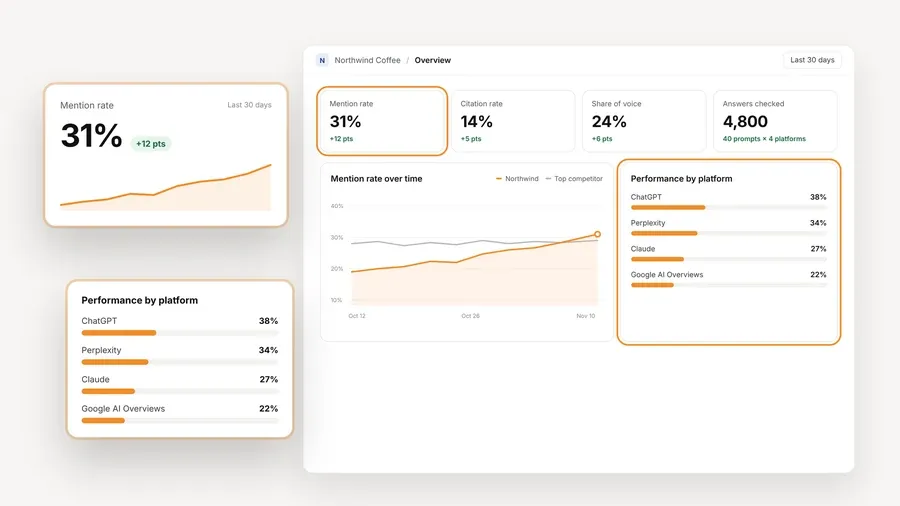
You choose how often to run, daily, twice a week or weekly, and for each engine you choose scraped data, which is the answer a real person sees in the app at the lowest cost, or API data from a specific model. Your keys can come from OpenAI, Anthropic, Gemini, Perplexity or DataForSEO. Keys are encrypted at rest and never shown again after you save them, and AeoNut recommends restricted keys with spending limits. Cost controls include the preview, spend per client, budget caps and alerts.
For the client conversation, white-label reports and shareable links carry your branding, not AeoNut's, and that holds on the Free plan too. Reports export as PDF, Excel and Markdown, and CSV export is available. A read-only MCP server lets an assistant like Claude read the workspace data and draft a summary, and a read-only REST API gives the same data at 120 requests a minute per workspace.

The Free plan holds one client project. If you grow to several clients, Pro is $99 a month, or $79 a month billed annually, for up to 10 client projects, and Unlimited is $499 a month, or $399 a month billed annually, for unlimited projects. Every plan includes every feature, so the only difference is how many projects you hold, and your history comes with you when you upgrade. As an example of data cost, 10 clients with 100 prompts each, tracked daily on ChatGPT, Perplexity and Google AI Overview, comes to about $135 a month in provider data. Your own number depends on your engines, prompts and schedule, and the cost preview gives you the estimate first.
Best for: A buyer who values Similarweb's real-user prompt data, wants AI visibility inside its wider AI Search Intelligence offering, and will pay for a defined prompt allowance.

Similarweb's AI Brand Visibility is a separate product from its AI Traffic tool. The visibility product measures whether a brand appears in generative AI answers, which sources shape those answers, and how the brand compares across tracked topics. The traffic tool measures visits that come from AI conversations, and that is outside this article.
Here are the package prices as published. AEO Intelligence is $129 a month, or $99 a month billed annually, with one user, 150 tracked prompts and three months of historical data. It includes AI Brand Visibility, Sentiment Analysis and Citation Analysis. The next package, AEO & SEO & Competitive Intel, is $399 a month, or $333 billed annually, with six months of history. The top package, AEO & SEO & Ads & Competitive Intel, is $649 a month, or $542 billed annually, also with 150 prompts and six months of history. The two larger packages add SEO and competitive functions that a tracker doesn't replace, so they aren't a fair comparison for this job.
The method is where Similarweb is genuinely different. It says it uses real-user prompt data, normalizes and aggregates those prompts, and records real AI responses every day. Setup asks for your domain, brand name and variations, region and language, and a mix of topics. It then surfaces the prompts that matter for each topic, and you can edit topics and prompts after you create the campaign. Region and language can't be changed once the campaign exists. A campaign selects one brand, and the reporting shows the top 30 brands for each tracked topic.
The scoring is simple enough to reproduce in spirit. Each brand mention scores 1 for that response, and visibility is calculated over the responses in the period you pick. Brand Mention Share is your share of all brand mentions across prompts in the tracked topics. Sentiment sorts mentions into positive, neutral or negative, and citation analysis lists the influencing domains and exact URLs. Prompt Analysis shows the question, the generated answer, the brands mentioned and their order, and the sources. The current product FAQ names four engines for the tracker: ChatGPT, Google AI Mode, Gemini and Perplexity. There is also an API that returns visibility, mention share, total mentions and period change for those engines, though the documentation reviewed does not say which plan unlocks it.
Is there a free way in? This is where the research came up short, so here is exactly what we found. The pricing page labels the packages "Try for free". It doesn't spell out whether that is a permanent free plan, how long a trial lasts, or whether a card is needed for this package. Similarweb's general trial help describes a seven-day trial that charges the card you sign up with unless you cancel in time, but it names other products as the trial options and doesn't confirm that AI Brand Visibility is included. Its free data on the site is a high-level sample with no deeper drill-downs. So we can't call any of this a free tracker, and the sensible move is to ask Similarweb directly before you count on a trial.
One honest limitation: The dedicated package is a single-user, 150-prompt plan with three months of history, at a price that is a long way from free. Its real-user prompt sourcing is a real strength, and a tracker built around your own prompts won't reproduce that sampling exactly.
Best for: A consultant who wants to test scheduled tracking in a hosted dashboard with no card and can live with a small prompt list and a slower schedule.

GEOflux has an ongoing free plan that is separate from its paid-plan trial. From its pricing page, the Free plan is $0 forever with no card and no time limit. It lists 45 credits, equal to 15 prompts, three competitors, reports, CSV export, email digests and competitor gap analysis, and it refreshes every three days. The page says the free offer is limited to 500 accounts, so check that it is still open when you read this.
Paid plans start with Starter at $99 a month for 150 credits and daily tracking, and Growth at $199 a month for 450 credits with priority support and engine selection. There is also a 14-day, no-card trial of Starter or Growth, which is different from the Free plan. Annual billing is offered at two months free, though the pricing page doesn't state annual dollar amounts. Seats are unlimited with no per-seat fees.
Credits work differently from a flat prompt count. Engines cost different amounts: ChatGPT, Gemini, Google AI Mode and Google AI Overviews are one credit each, while Perplexity, Copilot, Claude and Grok are three. Credits are held by the prompts you track, not used up at each run, so your existing prompts keep running, but adding a prompt or an engine needs freed credits, a credit pack or a bigger plan. GEOflux tracks the answers shown in the engines' own apps and keeps the answers and their sources. Reports can be shared by link without a login.
One honest limitation: Free is 15 prompts on a three-day schedule with three competitors, which is a demonstration and not a full client prompt set. Its pricing page lists ChatGPT, Gemini and Google AI Mode for Free, while its homepage says every plan tracks ChatGPT, Gemini and Perplexity, so confirm the engines on the current page before you promise one to a client. White-label reporting isn't established for its standard plans.
Best for: A consultant or small team ready to pay for a larger prompt allowance, wide engine coverage, many projects and API or CSV access.

LLMrefs has one plan on its pricing page, All in One at $79 a month, with 500 prompts, unlimited projects and unlimited team members. It offers a seven-day free trial with no card, and you can cancel anytime. That is a trial, not an ongoing free plan, and no annual price is stated in the pricing material we reviewed.
Its engine list is broad: ChatGPT, Google AI Overview, AI Mode, Gemini, Perplexity, Claude, Grok, Copilot and Meta, with the engines included at no extra fee. The method is keyword-first and not prompt-list-first. It generates fan-out queries from real user conversations and weights the results across prompts for each keyword. You get brand share of voice and position, cited source URLs, competitor benchmarking, weekly visibility reports, CSV export and API access, and each keyword updates at least weekly.
One honest limitation: It isn't the closest answer for a free tracker that stays free after a trial, and the keyword and fan-out approach is not a like-for-like swap for tracking the same fixed questions elsewhere. Its geography claims also differ by page. The pricing page says 50+ countries and 20+ languages, while another page says 20+ and 10+, so check before you sell a specific market.
Best for: A buyer who wants a packaged, credit-metered tracker with published plan limits and integrations, and is happy to pay monthly.

OtterlyAI shows prices in euros and says taxes are excluded. Lite is €29 a month for 16 prompts and 2,000 credits, Standard is €189 for 120 prompts and 15,000 credits, and Premium is €489 for 403 prompts and 50,000 credits. Enterprise is custom, starting from 1,000 prompts. These are the allowances the pricing page listed when we researched it, and the page can change, so check the current numbers. Each paid tier lists four of seven engines, and Enterprise lists unlimited engines. The seven are ChatGPT, Google AI Overviews, Perplexity, Microsoft Copilot, Google AI Mode, Gemini and Claude. A 15% annual option is mentioned, but the annual prices aren't stated in the pages reviewed.
One credit is one prompt checked once on one engine, and Claude uses three credits per answer. A daily prompt on one engine uses 31 credits a month. Its help page describes a seven-day trial with no card and 50 search prompts. You get brand visibility, sentiment, share of voice, citations and source classification, with detailed reports and exports on every plan. Lite leaves out API and MCP access, Standard lists 2,000 monthly requests of each, and Premium lists 5,000. Custom branded Looker Studio reports go to its Agency Partners, so don't assume white-label reporting comes with the standard plans.
One honest limitation: The free access is a seven-day trial, and the normal plans carry finite prompt and credit allowances. It doesn't meet a need for lasting free tracking of an open-ended prompt set.
A free tracker can give you a trustworthy, repeatable picture of one brand, as long as you keep the sample steady. For each prompt, log the engine, the country, the date, the full answer, whether the brand appears, where it appears, which competitors are named, the sentiment and the cited sources. From that you can work out the numbers a client cares about:
AeoNut covers all of those for the prompt set you configure, which answers the practical client question: do we show up for what our buyers ask, and which sources do the engines cite?
Here is what you can't reproduce. Similarweb's real-user prompt universe, its normalization, its prompt discovery and its sampling belong to Similarweb. A prompt list you pick yourself is evidence about that list, and it isn't the whole AI search population. So decide your prompts, engines, country and schedule before you start, and compare like with like from month to month. And keep in mind that a mention or a citation is not a visit. Whether an answer sent anyone to the site is a traffic question, which is what Similarweb's other products are for.
Pick based on the situation you are in, not on the longest feature list.
For a one-person shop, the real decision is whether a zero platform fee and an open prompt list are worth managing provider costs yourself, or whether a hosted plan with a defined dataset and fixed limits is worth the monthly bill. If you are not sure, you can try the free route first, because it costs nothing to set up and you'll see your own numbers.
If you are ready to try a free Similarweb AI visibility alternative on a real client, start with AeoNut's Free plan. It is one brand, unlimited prompts and every feature, with no card and no platform fee. The AI answer data is billed by your own provider at its price, and the cost preview shows the estimate before tracking runs, so you stay in control of the spend.
Yes. AeoNut has a free-forever plan for one project with unlimited prompts and every feature, and provider data charges still apply. GEOflux also has an ongoing free plan, but it is limited to 15 prompts, three competitors and a three-day refresh. Both are worth trying as a Similarweb AI brand visibility alternative when you track a single brand.
The platform fee on the Free plan is $0. The AI answer data is billed by your connected provider at its prices, and AeoNut shows an estimated monthly cost before tracking runs, with budget caps and alerts to keep spend in check.
It can measure mentions, competitor share of voice, citations, sentiment and answer position for the prompts and engines it tracks. It can't reproduce Similarweb's real-user prompt sample, normalization or exact results. A fair comparison needs the same prompts, engines, country and time period.
We couldn't confirm one. The package page says "Try for free", and Similarweb offers limited free data samples, but the research found no permanent free AI Brand Visibility plan. Its general trial help describes seven days with automatic billing unless you cancel, and it doesn't confirm that AI Brand Visibility is part of that trial. Treat Similarweb AI tracking free access as a trial question and ask Similarweb before you rely on it.
Tools & Comparisons ·
Compare free tools that report citation rate and brand mention rate as separate numbers, and see which are ongoing plans and which are one-time checkers.

Tools & Comparisons ·
Is a self-hosted AI visibility tracker worth your time? Compare setup, upkeep, data control and engine coverage with a managed free plan before you decide.

Tools & Comparisons ·
Which free AEO tracking tool keeps running, saves history and shows change? Compare five free options on schedule, trends and alerts to pick one for a client.